

In an era of rising inflation and increasing unit rates from DISCOMs, homeowners across India are constantly looking for ways to stabilize their monthly expenses. One of the most effective methods to achieve financial predictability is transitioning to solar energy. Specifically, electricity bill savings with 3kW solar plant installations have proven to be the most viable solution for the average Indian middle-class household. A 3kW system represents the “Goldilocks” zone—not too big, not too small, but just right for maximizing return on investment (ROI).
This article dives deep into the financial mechanics of going solar in the Indian market. We will explore the long-term savings, breaking down the costs in Rupees, the payback period without complex math, and the massive profits you can accrue over the system’s 25-year lifespan.
Why 3kW Systems Maximize Electricity Bill Savings with 3kW Solar Plant
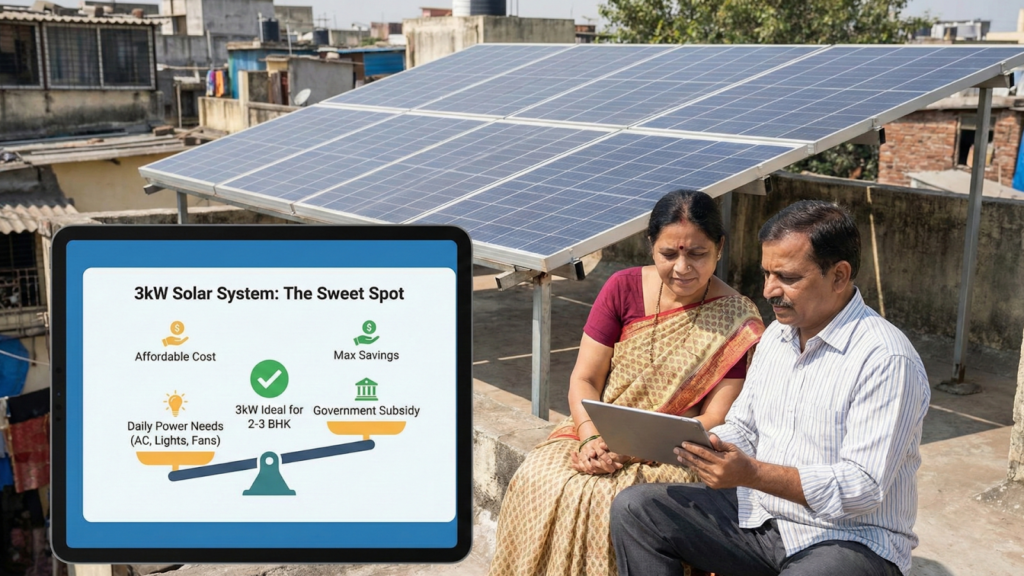
Before analyzing the financials, it is essential to understand why the 3kW model is the most popular choice for homeowners in cities like Jaipur, Delhi, Bangalore, and Mumbai.
A 3kW (kilowatt) on-grid solar system is typically sufficient to run the sanctioned load of a standard 2-3 BHK home in India. This includes lights, fans, a refrigerator, a television, a washing machine, and even a 1.5-ton inverter air conditioner for limited hours during the day.
Key Technical Specifications:
- Space Required: Approximately 300 square feet of shadow-free roof area.
- Panel Count: Usually 6 to 9 bifacial or mono-perc panels (depending on the wattage, e.g., 540W).
- Generation Capacity: On average, a 3kW system generates 12 to 15 units (kWh) of electricity per day in Indian weather conditions.
By generating your own power, you drastically reduce your dependence on the state electricity grid, which is the primary driver of electricity bill savings with 3kW solar plant setups.
The Initial Investment: What Are You Paying For?
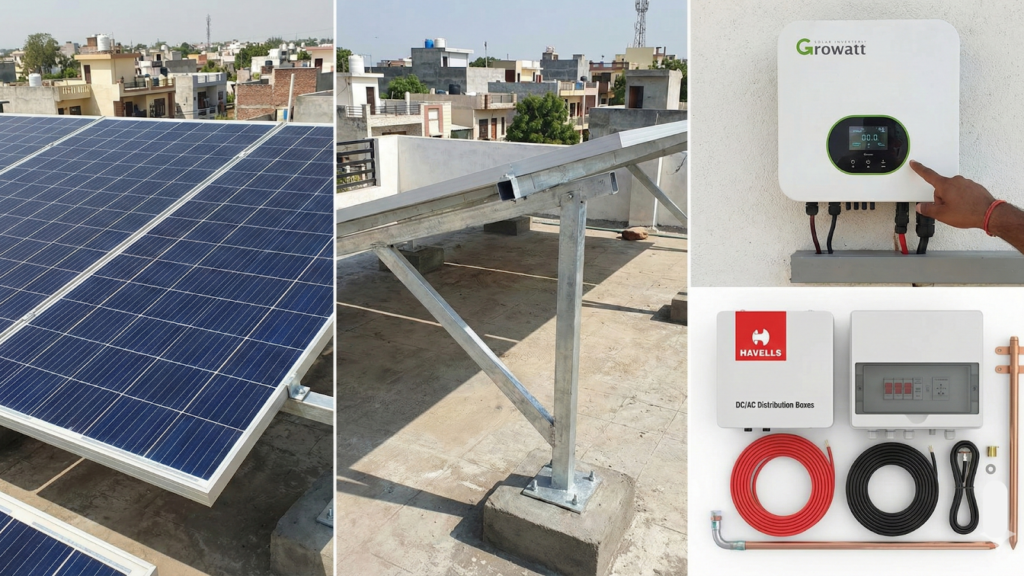
To calculate savings, we must first establish the cost. While prices vary based on your state, the brand of panels, and the structure height, here is a general breakdown of the initial capital expenditure (CAPEX) in India.
1. Solar Panels (PV Modules)
These are the heart of the system. In India, Monocrystalline PERC half-cut panels are currently the trend due to their high efficiency even in low light, though Polycrystalline panels remain a budget-friendly option.
2. Solar Inverter
The inverter converts the Direct Current (DC) from panels into Alternating Current (AC). Brands like Growatt, Solis, or Enphase are common in Indian households.
3. Mounting Structure
Given the high wind speeds in some Indian states, a robust Galvanized Iron (GI) structure is necessary to hold the panels securely.
4. Balance of System (BoS)
This includes DC/AC cables (usually Polycab or similar), distribution boxes (ACDB/DCDB), earthing kits, and lightning arresters, which are mandatory for safety.
Cost Estimate: A premium 3kW system typically costs between ₹1,60,000 to ₹2,00,000 before subsidy. With the PM Surya Ghar: Muft Bijli Yojana, you can get a subsidy of up to ₹78,000, significantly bringing down your net cost.
Calculating the Electricity Bill Savings with 3kW Solar Plant
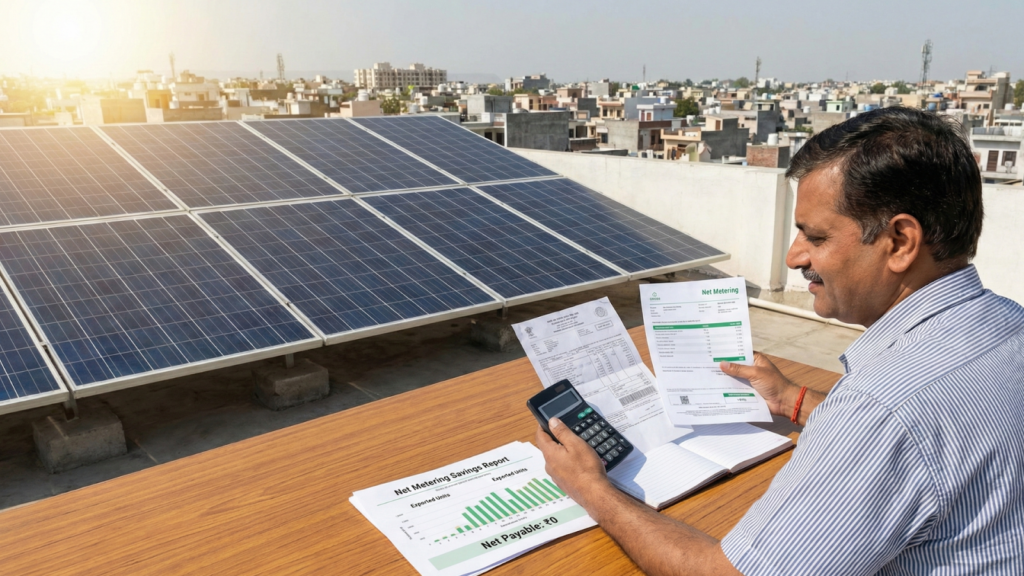
The core of the financial argument for solar in India is “Net Metering.” This is a billing mechanism approved by most state electricity boards (like JVVNL, BESCOM, MSEDCL) that credits solar energy system owners for the electricity they add to the grid.
When your 3kW system generates more power than you are using during the day (for example, when everyone is at the office or school), the bi-directional meter spins ‘backward’, exporting power to the grid. At night, you import power. At the end of the month, you only pay for the net difference.
The Mathematics of Daily Savings
Let’s assume the following conservative estimates for an Indian household:
- Average Generation: 12 units per day.
- Annual Generation: 12 units x 300 sunny days = 3,600 units/year.
- Grid Electricity Rate: ₹8 per unit (Average slab rate in many states).
If you were to buy these 3,600 units from your electricity board, you would pay a hefty sum. By generating them yourself, you save that cash.
Table 1: Estimated Monthly and Annual Savings
Below is a breakdown of how the electricity bill savings with 3kW solar plant accumulate over the first year.
| Month | Avg. Daily Generation (Units) | Total Monthly Generation (Units) | Grid Tariff (Per Unit) | Monthly Savings (₹) |
| January | 11 | 341 | ₹8.00 | ₹2,728 |
| February | 12 | 336 | ₹8.00 | ₹2,688 |
| March | 14 | 434 | ₹8.00 | ₹3,472 |
| April | 15 | 450 | ₹8.00 | ₹3,600 |
| May | 15 | 465 | ₹8.00 | ₹3,720 |
| June | 14 | 420 | ₹8.00 | ₹3,360 |
| July | 11 | 341 | ₹8.00 | ₹2,728 |
| August | 10 | 310 | ₹8.00 | ₹2,480 |
| September | 12 | 360 | ₹8.00 | ₹2,880 |
| October | 13 | 403 | ₹8.00 | ₹3,224 |
| November | 12 | 360 | ₹8.00 | ₹2,880 |
| December | 11 | 341 | ₹8.00 | ₹2,728 |
| Total | — | 4,561 Units | — | ₹36,488 |
(Note: Generation is usually higher in summer months like April/May compared to winter or monsoon months.)
ROI Analysis: When Do Electricity Bill Savings with 3kW Solar Plant Pay Off?
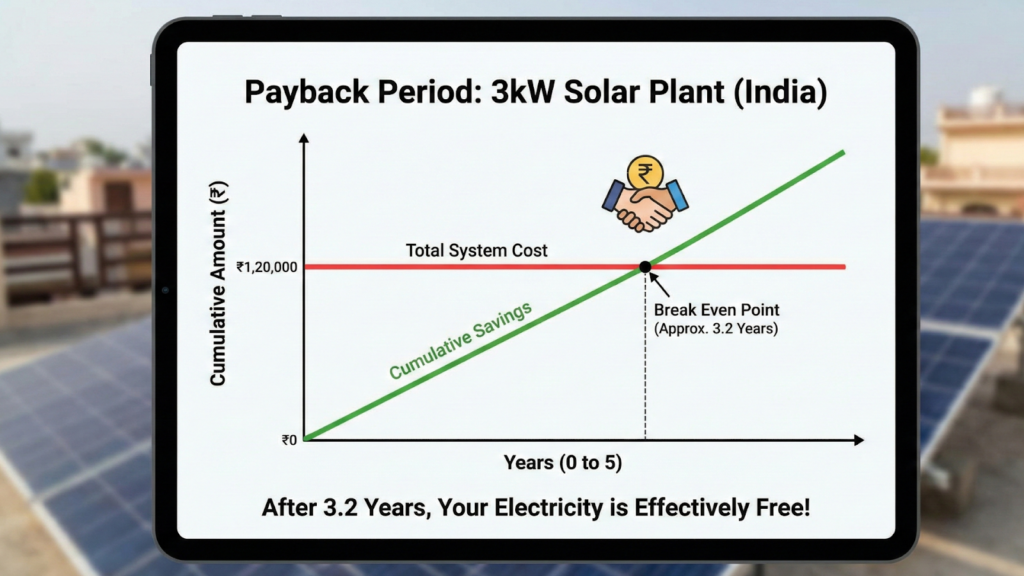
The “Payback Period” is simply the time it takes for your electricity bill savings to equal the amount you spent on buying the system.
Let’s look at the numbers simply:
- Net Cost of System (after Subsidy): Approx. ₹1,20,000
- Annual Savings: Approx. ₹36,500
To find out when you recover your money, you just divide the Cost by the Savings.
₹1,20,000 divided by ₹36,500 equals roughly 3.2 Years.
This means that in just over 3 years, you have recovered your entire investment. Since solar panels come with a performance warranty of 25 years, the remaining 21+ years are essentially free electricity. This return is tax-free and far higher than any Fixed Deposit or Mutual Fund available in India today.
Long-Term Projection: Electricity Bill Savings with 3kW Solar Plant Over 25 Years
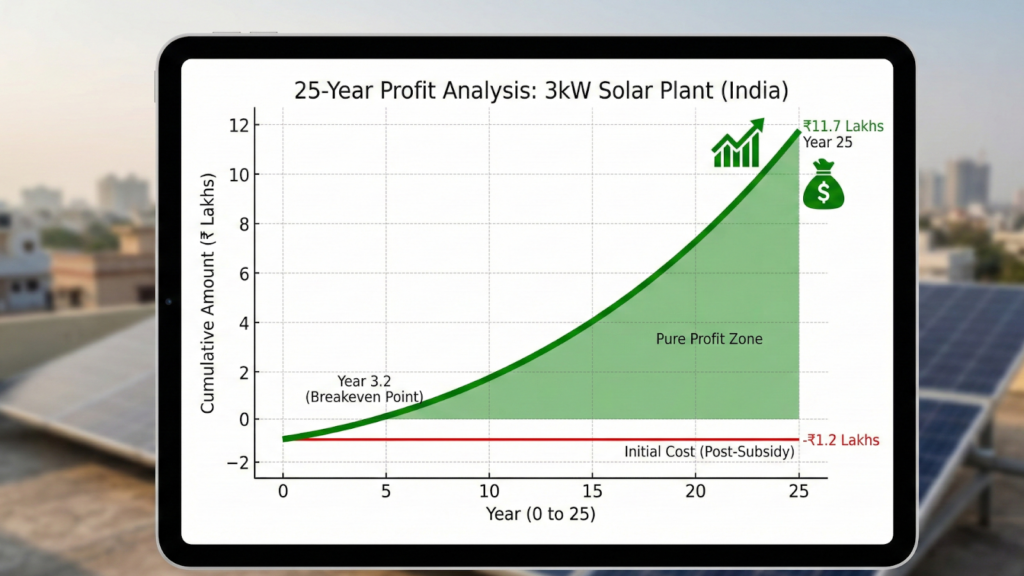
Many Indian homeowners fail to account for electricity inflation. Electricity boards in India historically raise prices by 2% to 5% every year due to rising coal costs and distribution losses. Your solar system protects you from this price hike.
When we look at the electricity bill savings with 3kW solar plant over a quarter of a century, the numbers are huge.
Table 2: 25-Year ROI Projection (Inflation Adjusted)
Assumption: Electricity tariff increases by 3% annually.
| Year Range | Est. Grid Tariff (Avg) | Annual Savings | Cumulative Savings | Maintenance Costs | Net Profit |
| Year 1-5 | ₹8.50 | ₹1,90,000 | ₹1,90,000 | ₹0 (Warranty) | Break Even & Profit |
| Year 6-10 | ₹9.80 | ₹2,20,000 | ₹4,10,000 | ₹5,000 | ₹2,85,000 |
| Year 11-15 | ₹11.30 | ₹2,55,000 | ₹6,65,000 | ₹20,000 (Inverter Change) | ₹5,25,000 |
| Year 16-20 | ₹13.00 | ₹2,95,000 | ₹9,60,000 | ₹5,000 | ₹8,35,000 |
| Year 21-25 | ₹15.00 | ₹3,40,000 | ₹13,00,000 | ₹5,000 | ₹11,70,000 |
By the end of year 25, a system that cost you roughly ₹1.2 Lakhs (post-subsidy) has generated over ₹11 Lakhs in pure profit. This is a massive return on investment.
Hidden Benefits Beyond the Bill
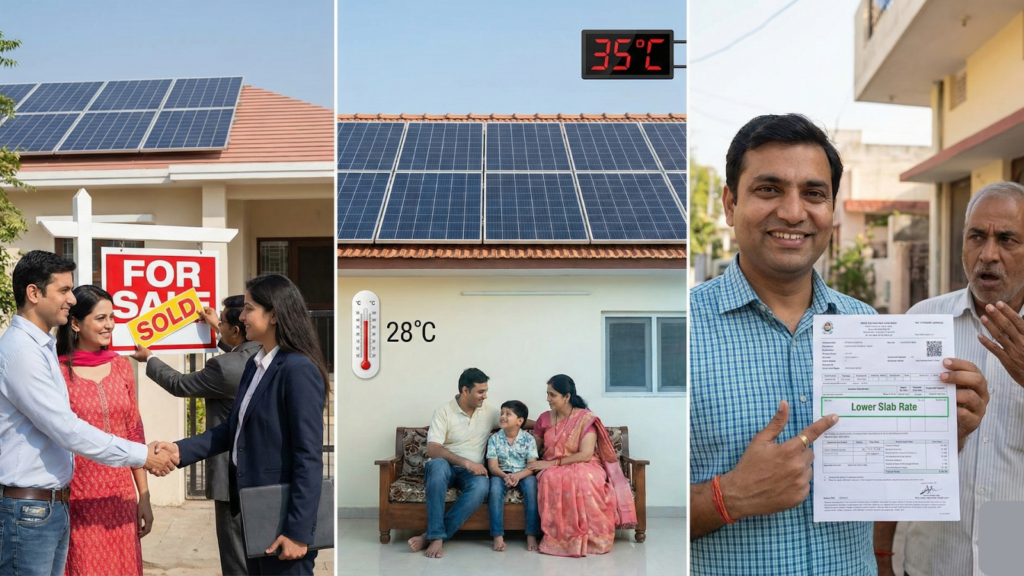
While the electricity bill savings with 3kW solar plant are the primary motivator, there are secondary benefits that add value to your property.
1. Protection from High Consumption Slabs
Most Indian states use a “slab” billing system. If you consume more than 200 or 400 units, the rate per unit jumps drastically. Solar keeps your net consumption low, ensuring that even if you do pay a bill, it is calculated at the cheapest base slab.
2. Increased Property Value
Homes in India equipped with functional solar power systems are easier to rent out and sell. Tenants prefer homes with lower utility bills, and buyers view the pre-installed system as a major asset.
3. Cool Roof Benefit
A hidden benefit often noticed in hot cities like Jaipur or Delhi is that solar panels installed on the roof absorb the sunlight, keeping the room directly below them significantly cooler (by 3-5 degrees) during the summer.
Key Factors That Affect Electricity Bill Savings with 3kW Solar Plant
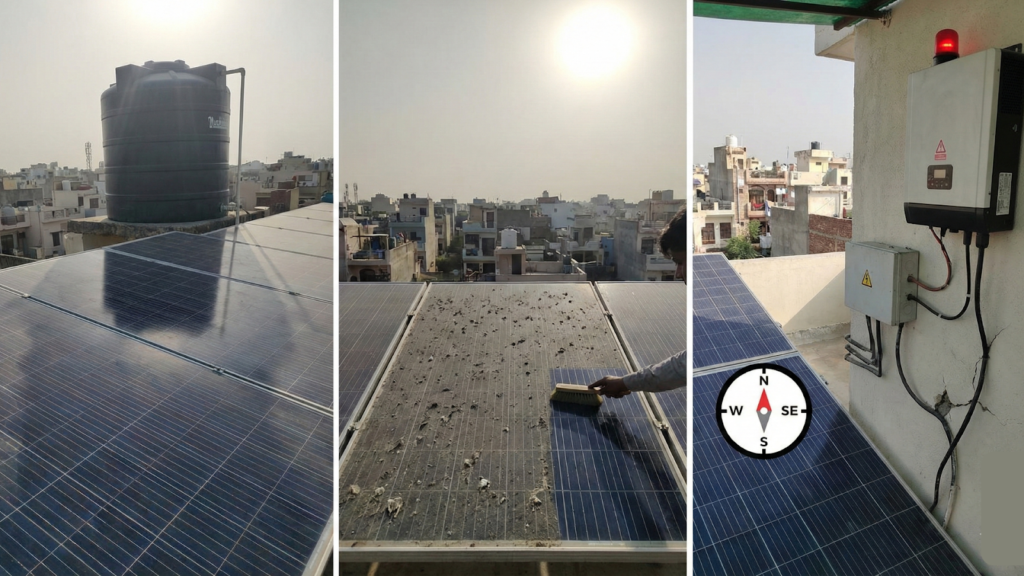
To ensure you actually achieve the predicted electricity bill savings with 3kW solar plant, keep these factors in mind:
- Shadow Analysis: Even a small shadow from a water tank or a neighbor’s building can drop system efficiency. Ensure a shadow-free installation.
- Direction (Azimuth): In India, panels must always face South. This captures the maximum sun as it moves from East to West.
- Dust and Cleaning: India is a dusty country. A layer of dust can reduce output by 15-20%. Regular cleaning (every 10-15 days) is mandatory to maintain savings.
- Equipment Quality: Don’t compromise on the inverter or cables to save a few thousand rupees. High-quality components ensure the system runs without faults for decades.
Conclusion: Securing Lifetime Electricity Bill Savings with 3kW Solar Plant
The decision to install solar in India is no longer just about being “green”; it is a smart financial strategy. The data is clear: the electricity bill savings with 3kW solar plant are substantial enough to pay for the system in just 3 to 4 years.
In a time where household expenses are rising, locking in your electricity cost at essentially “zero” is a brilliant move. Whether you want to save for your child’s education or build a retirement corpus, a 3kW solar plant is a silent, efficient money-making machine on your roof.
Start your solar journey today, and let the sun pay your bills for the next 25 years.
Frequently Asked Questions (FAQ) About Electricity Bill Savings with 3kW Solar Plant
Q1: How much roof area do I need for a 3kW solar plant?
A: You typically need about 300 square feet of shadow-free rooftop area. The roof should be accessible for cleaning purposes.
Q2: What happens to my savings during the monsoon?
A: Solar panels still generate electricity during cloudy days, but efficiency drops to 20-30%. However, thanks to ‘Net Metering’, the excess power you generated during the hot summer months is kept as a “credit” in your electricity bill, which is adjusted against your usage during the monsoon.
Q3: Can I run a 1.5 Ton AC on a 3kW system?
A: Yes, absolutely. A 3kW system can easily support a 1.5 Ton Inverter AC along with other household loads. It is best to run heavy appliances like ACs and Washing Machines during the day (10 AM to 4 PM) to use solar power directly.
Q4: Is there a subsidy for 3kW solar plants in India?
A: Yes! Under the PM Surya Ghar: Muft Bijli Yojana, the central government provides a substantial subsidy (up to ₹78,000 for systems above 2kW). Some state governments may offer additional benefits.
Q5: What is the maintenance cost?
A: Maintenance is very low. It mostly involves cleaning the panels with water every two weeks. There are no moving parts, so wear and tear is minimal. You may need to replace the inverter once after 10-12 years, which costs around ₹20,000.
