The solar energy landscape is undergoing a massive shift. For the past decade, PERC (Passivated Emitter and Rear Cell) technology has been the industry standard. However, as PERC reaches its theoretical efficiency limits, a new contender has emerged to take the throne. If you are researching the latest in photovoltaics, you have likely come across a pressing question: What are TOPCon solar technology panels?
This guide will dive deep into the mechanics, benefits, and future of TOPCon technology, explaining why it is rapidly becoming the new standard for residential and commercial solar installations.
Introduction: The Evolution of PV and What are TOPCon Solar Technology Panels?

To understand where the industry is going, we must look at where it has been. Solar manufacturers are in a constant race to squeeze more electricity out of the same amount of sunlight. Standard P-type PERC cells generally max out at around 22% efficiency. To break this glass ceiling, engineers turned to N-type silicon and a new cell architecture known as TOPCon.
But, specifically, what are TOPCon solar technology panels?
In short, TOPCon stands for Tunnel Oxide Passivated Contact. It is a more advanced solar cell architecture that reduces “recombination” (the loss of electrons), thereby allowing the panel to convert more sunlight into electricity than its predecessors. It is not just a minor upgrade; it is a generational leap in PV technology.
Deep Dive: What are TOPCon Solar Technology Panels?
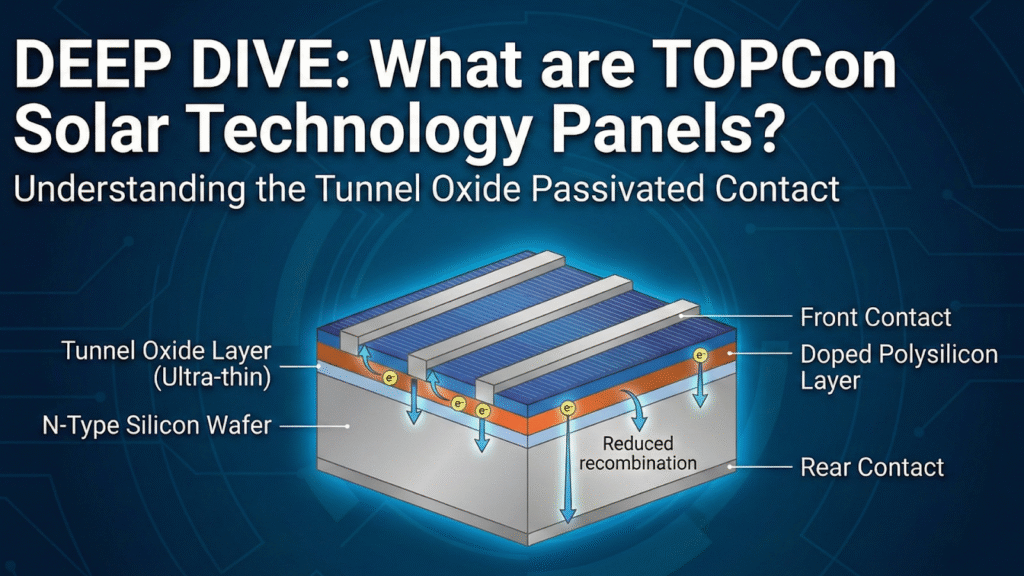
At its core, TOPCon technology is about fixing the “leaks” in a solar cell. In a traditional solar cell, when sunlight hits the silicon, it knocks electrons loose, creating an electric current. However, some of these electrons get trapped or lost before they can be harvested—a process called recombination.
TOPCon addresses this by adding a microscopic layer of ultra-thin oxide (the “Tunnel Oxide”) and a layer of doped polysilicon to the rear of the cell.
The Science Behind TOPCon Solar Technology Panels
- N-Type Silicon Base: unlike older panels that use P-type (boron-doped) silicon, TOPCon uses N-type (phosphorous-doped) silicon. N-type cells are naturally more resistant to impurities and degradation.
- The Tunneling Layer: The “magic” happens in the tunnel oxide layer. It acts as a gatekeeper. It allows the current carriers to pass through easily (tunneling) while blocking the minority carriers that cause energy loss.
This combination results in a cell that is highly efficient and performs exceptionally well even in hot climates.
Comparative Analysis: What are TOPCon Solar Technology Panels vs. PERC

The most common question homeowners ask after “What are TOPCon solar technology panels?” is how they compare to the current standard, PERC.
While PERC was revolutionary in 2015, TOPCon offers significant improvements in almost every metric.
TOPCon vs. PERC Technology Comparison
| Feature | P-Type PERC Technology | N-Type TOPCon Technology | Winner |
| Max Cell Efficiency | ~23% – 24% | ~25% – 28% | TOPCon |
| Module Efficiency | 20% – 21.5% | 22% – 23.5%+ | TOPCon |
| Bifaciality | ~70% (Energy from back) | ~80-85% (Energy from back) | TOPCon |
| Temp. Coefficient | -0.34% / °C | -0.30% / °C (Better in heat) | TOPCon |
| Degradation (Year 1) | ~2.0% | ~1.0% | TOPCon |
| Annual Degradation | ~0.55% | ~0.40% | TOPCon |
| Manufacturing Cost | Low | Moderate (Decreasing rapidly) | PERC |
Key Takeaway: While PERC is cheaper to make right now, TOPCon produces more power over the system’s lifetime, offering a better Return on Investment (ROI) in the long run.
Key Benefits: What are TOPCon Solar Technology Panels Bringing to Homeowners?
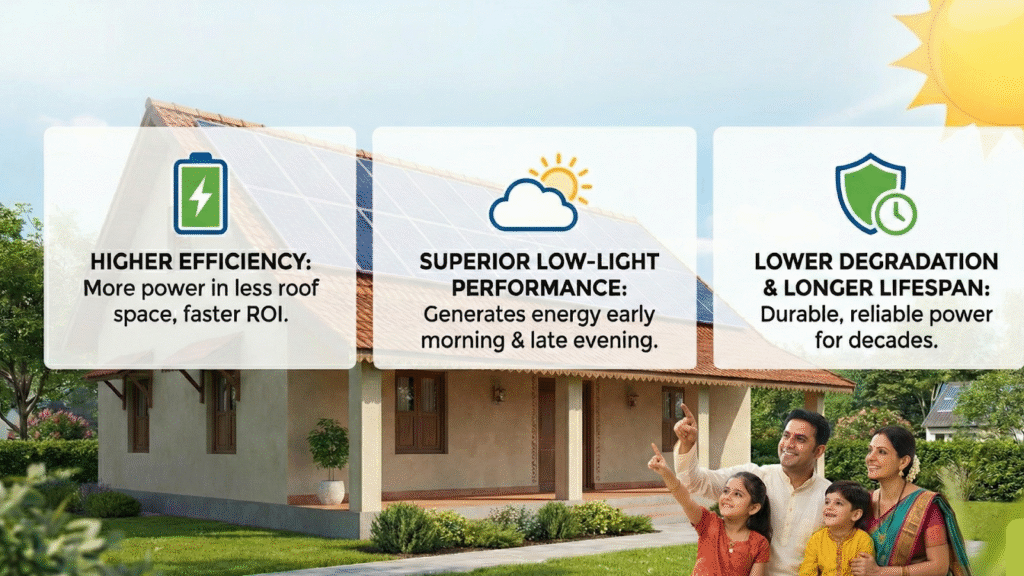
The shift to TOPCon isn’t just about laboratory numbers; it translates to real-world benefits for solar system owners.
1. High Efficiency Gains with TOPCon Solar Technology Panels
Because TOPCon panels have a higher conversion rate, you can generate more power with fewer panels. This is crucial for residential roofs with limited space. A 430W TOPCon panel is often the same physical size as a 400W PERC panel.
2. Low Light Performance of TOPCon Solar Technology Panels
What are TOPCon solar technology panels capable of doing in cloudy weather? Quite a lot. Due to the N-type silicon base, these panels are more sensitive to low-light conditions, meaning they start producing power earlier in the morning and stop later in the evening compared to standard panels.
3. Zero LID (Light Induced Degradation)
P-type PERC panels suffer from something called the Boron-Oxygen defect.10 When they are first exposed to sunlight, they lose about 2-3% of their power immediately.
TOPCon panels use Phosphorous instead of Boron, eliminating this specific defect.11 This means you get the power you paid for from Day 1.
4. Temperature Stability: What are TOPCon Solar Technology Panels Like in Heat?
Solar panels actually hate heat. As temperatures rise, efficiency drops. TOPCon panels have a lower “temperature coefficient.” Simply put, on a hot summer day in India or Australia, a TOPCon panel will maintain its power output better than a standard panel.
Manufacturing Insight: How TOPCon Solar Technology Panels Are Produced
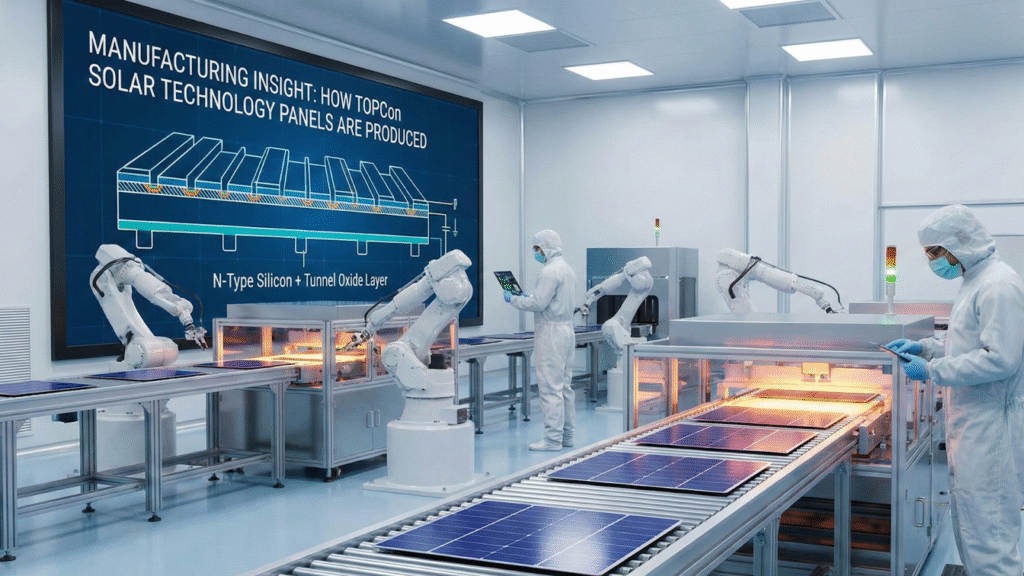
One of the main reasons TOPCon is winning over other high-tech options (like HJT or IBC) is manufacturing compatibility.
Solar manufacturers do not need to build entirely new factories to produce TOPCon. They can upgrade their existing PERC production lines with a few additional steps. This ease of upgrade is keeping costs down and ensuring that TOPCon solar technology panels become widely available very quickly.
N-Type vs. P-Type: Understanding the Materials
To fully grasp the answer to “What are TOPCon solar technology panels?”, we must look at the raw material: the Silicon Wafer.
- P-Type (Positive): Doped with Boron. This has been the standard for 40 years. It is susceptible to light-induced degradation.
- N-Type (Negative): Doped with Phosphorus. It has a longer “carrier lifetime” (electrons survive longer).
N-Type vs. P-Type Material Analysis
| Characteristic | P-Type Silicon (Standard) | N-Type Silicon (TOPCon/HJT) |
| Primary Dopant | Boron | Phosphorus |
| Tolerance to Impurities | Low | High |
| LID (Light Induced Degradation) | Prone to Boron-Oxygen defects | Immunity to Boron-Oxygen defects |
| Electron Flow | Standard | Enhanced |
| Cost | Lowest | Slightly Higher |
| Market Share Trend | Declining | Rapidly Increasing |
The Future of TOPCon and Solar PV
Is TOPCon the final destination for solar? Not necessarily, but it will be the dominant technology for the next 5 to 10 years.
Major manufacturers like Jinko Solar, Trina Solar, and JA Solar have already shifted the majority of their production capacity to N-type TOPCon. The efficiency of these panels is expected to climb toward 28% in mass production over the next few years.
While other technologies like Heterojunction (HJT) and Tandem Perovskites exist, they are currently much more expensive to manufacture. TOPCon hits the “sweet spot” of high performance and reasonable cost.
Conclusion: Summarizing What are TOPCon Solar Technology Panels
As we look toward a greener future, efficiency is key. So, when you ask, “What are TOPCon solar technology panels?”, the answer is: they are the new benchmark for performance.
By utilizing N-type silicon and advanced passivation layers, TOPCon technology offers higher efficiency, lower degradation, and better performance in hot and low-light conditions. For homeowners and businesses looking to maximize their energy generation and secure a long-term investment, choosing TOPCon over older PERC panels is a smart financial decision.
If you are planning a solar installation in 2024 or beyond, ensure your quote includes N-type TOPCon panels to future-proof your energy system.
FAQ: Common Questions About What are TOPCon Solar Technology Panels
Q1: What are TOPCon solar technology panels exactly?
A. TOPCon stands for Tunnel Oxide Passivated Contact. It is a new type of solar cell technology that uses N-type silicon and a special tunnel oxide layer to reduce energy loss, resulting in higher efficiency compared to standard panels.18
Q2: Are TOPCon panels more expensive than PERC panels?
A. Currently, TOPCon panels are slightly more expensive upfront than PERC panels (typically 10-20% higher). However, because they generate more electricity over 25-30 years and degrade slower, the total cost of energy is often lower.
Q3: What is the lifespan of a TOPCon solar panel?
A. Most TOPCon panels come with a 30-year power warranty. Because they do not suffer from Light Induced Degradation (LID) as much as P-type panels, they are expected to retain over 87% of their initial power output even after 30 years.
Q4: Can I use TOPCon panels with my existing inverter?
A. Yes. TOPCon panels function just like standard panels electrically. They are compatible with standard string inverters, microinverters, and power optimizers available in the market today.
Q5: Is TOPCon better than HJT (Heterojunction)?
A. HJT theoretically has slightly higher efficiency potential than TOPCon. However, HJT is currently much more expensive to manufacture and has issues with UV stability and water sensitivity. For the current market, TOPCon offers the best balance of price and performance.
