
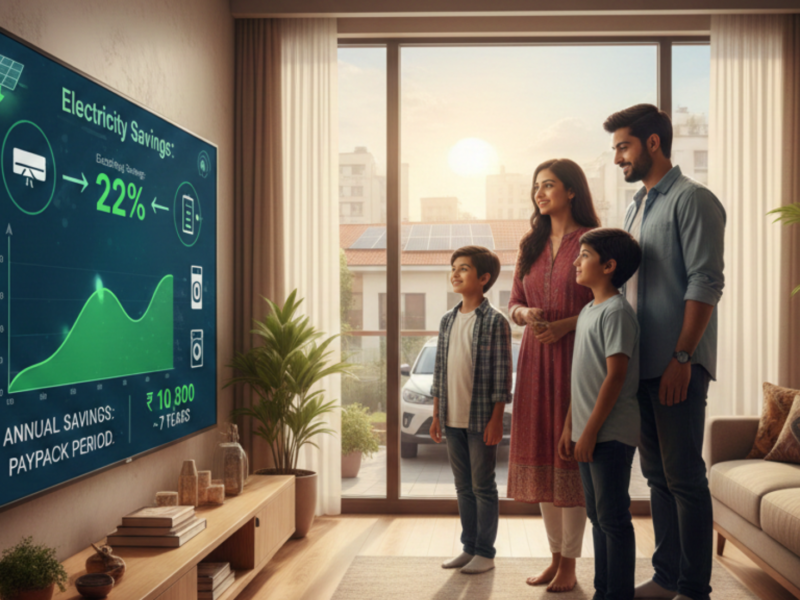
In India, where electricity tariffs can be complex, and the adoption of solar and electric vehicles (EVs) is rapidly increasing, controlling and optimizing home energy usage is more critical than ever. The Home Energy Management Systems (HEMS) is emerging as a powerful solution, promising significant reductions in electricity bills and a lower carbon footprint.
But the question on every Indian homeowner’s mind is practical and financial: What is the actual cost of installing a Home Energy Management System, and does the eventual saving justify the upfront investment?
This comprehensive guide delves into the expenses in INR, explores the potential for energy cost reduction, and provides a clear framework for determining the Return on Investment (ROI) for a Home Energy Management System in the Indian context.
Defining the Home Energy Management System (HEMS)
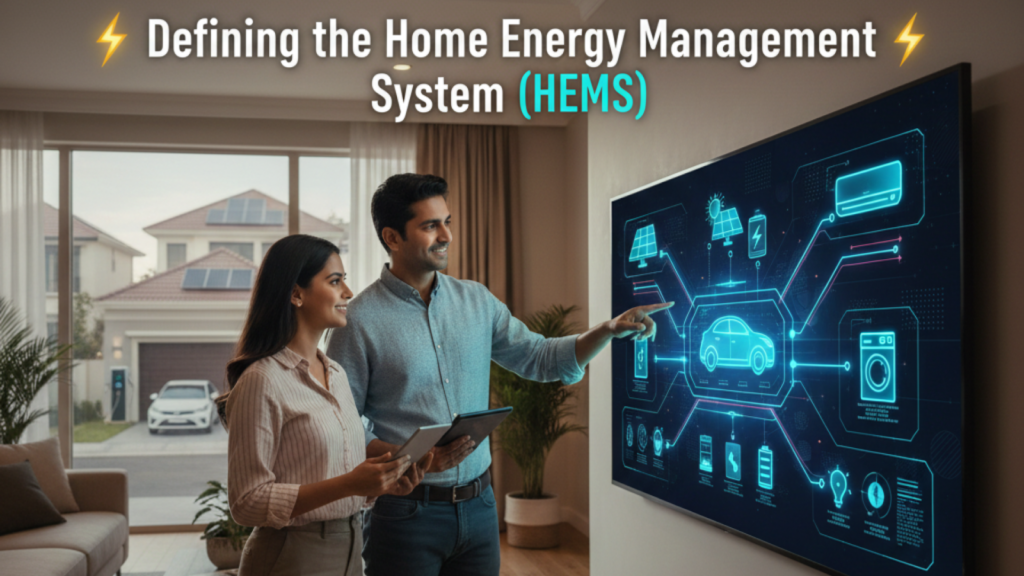
A HEMS is a sophisticated, centralized digital platform—a combination of hardware (smart meters, sensors, and a central hub) and advanced software (mobile apps and dashboards)—designed to monitor, analyze, and automatically manage a home’s total energy consumption and generation.
It moves beyond a simple switch or smart plug. A HEMS acts as an intelligent, automated energy supervisor, making real-time decisions to use electricity most efficiently, especially crucial in Indian homes with high Air Conditioner (AC) usage, growing EV adoption, and solar power integration.
Key Functions of a HEMS in India:
- Real-Time Monitoring: Tracks energy usage circuit-by-circuit, identifying high-consumption appliances like geysers and high-tonnage ACs.
- Load Balancing & Scheduling: Automatically schedules heavy loads (like water pumps or washing machines) during off-peak hours or when solar power is abundant, maximizing savings on complex Time-of-Day (ToD) tariffs.
- Solar Self-Consumption: Intelligently manages solar PV systems and home battery storage to ensure that maximum self-generated power is utilized before drawing from the grid (essential for optimizing Net-Metering benefits).
- EV Charging Management: Schedules EV charging to occur during the cheapest electricity hours, which is vital as charging an EV can significantly spike a residential bill.
- Demand Reduction: Helps homeowners participate in future utility Demand Response programs by automatically shedding non-essential load during peak grid stress.
Breaking Down the Initial Cost of a Home Energy Management System in INR

The cost of a Home Energy Management System in India varies significantly based on its scope, the brand (domestic vs. international), and the complexity of integration (especially with existing solar or backup inverter setups).
We categorize the investment into three main components: Hardware, Installation, and Software/Service Fees.
1. Hardware and Components (Estimated Cost in INR)
The hardware forms the largest portion of the initial expenditure. Based on current market prices from Indian suppliers and manufacturers, here is an estimated breakdown:
| HEMS Component | Estimated Cost Range (INR) | Function and Scope |
| Basic Smart Plug/Switch Modules | ₹ 1,200 – ₹ 3,500 each | Entry-level load control for individual appliances (lights, fans, geysers). |
| Central Gateway/Hub (The Brain) | ₹ 5,000 – ₹ 15,000 | The coordinator for all devices and communication with the cloud/app. |
| Whole-Home Energy Monitor (with CT Clamps) | ₹ 8,000 – ₹ 25,000 | Provides granular, feeder-level or circuit-level data for comprehensive analysis. |
| Integrated Solar/Battery Module | ₹ 15,000 – ₹ 40,000+ | Required for homes with solar PV to intelligently manage generation and storage. |
| Smart EV Charger Integration | ₹ 5,000 – ₹ 15,000 (Interface Cost) | Allows the HEMS to optimize the EV charging schedule according to tariffs. |
Total Estimated Hardware Cost:
- Basic HEMS (Monitoring + Basic Control): For a simple setup focusing on monitoring and automating 5-10 key loads, the cost typically ranges from ₹ 15,000 to ₹ 35,000.
- Advanced HEMS (Solar/EV Integration + Whole-Home Control): For a comprehensive, integrated system, the hardware investment can range from ₹ 45,000 to ₹ 90,000 or higher, depending on the number of circuits monitored and the level of automation.
2. Installation and Labor Charges
Professional installation is recommended, particularly for systems involving high-voltage wiring within the distribution board.
- Simple Setup (DIY/Minimal Wiring): If you are only installing smart plugs and a hub, labor costs are minimal.
- Advanced Setup (Professional Wiring): Installing a whole-home energy monitor or solar/EV integration components requires a qualified electrician or HEMS technician. Labor charges can range from ₹ 5,000 to ₹ 15,000, depending on location (Tier-1 vs. Tier-2 cities) and complexity.
3. Software and Subscriptions
While many basic Indian HEMS vendors offer free, lifetime app access, some sophisticated, AI-driven platforms with advanced predictive analytics or dedicated cloud storage may have subscription models.
- Annual/Monthly Fee: Expect to pay an estimated ₹ 500 to ₹ 1,500 per month (or an equivalent annual fee) for premium SaaS (Software as a Service) features that offer deep, AI-powered optimization.
Calculating the ROI: Is the Investment in a Home Energy Management System Profitable?
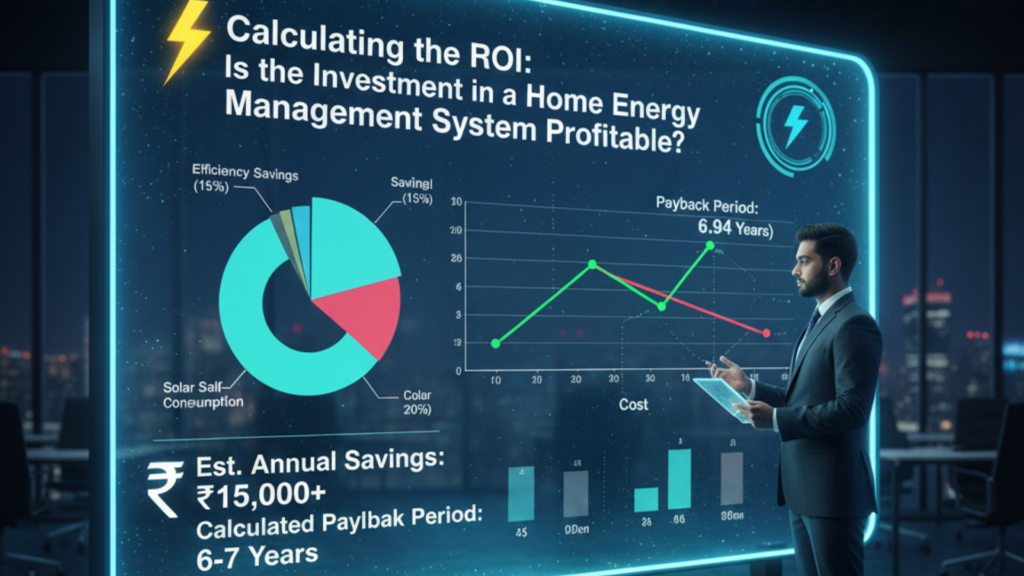
The core calculation for justifying the initial investment is the Return on Investment (ROI) and the Payback Period.
The Energy Savings Potential in India
A well-implemented HEMS can generate substantial savings, primarily through three methods, highly relevant to Indian consumption patterns:
- Direct Efficiency Savings (10% – 20%): A HEMS eliminates unnecessary consumption (phantom loads) and optimizes appliances like ACs and geysers. This visibility and control typically lead to a 10% to 20% reduction in total electricity units consumed.
- ToD Tariff Optimization: Many state electricity boards (like in Maharashtra, Delhi, or Karnataka) implement Time-of-Day tariffs where peak-hour electricity is significantly more expensive. The HEMS automatically shifts usage to cheaper off-peak hours, a major source of savings for Indian urban families.
- Solar ROI Acceleration: For solar homeowners, the HEMS maximizes self-consumption of solar energy. By intelligently diverting solar power to run appliances or charge batteries instead of sending it to the grid for often lower Net-Metering credit, it dramatically improves the financial returns of the solar system.
The Payback Period Calculation (INR)
The simplest way to calculate the payback period is:
Payback Period (Years) = (Initial HEMS Cost) / (Annual Electricity Bill Savings)
Example Scenario (Average Urban Indian Home):
Consider a typical urban household with an average monthly bill of ₹ 4,500, resulting in an Annual Electricity Bill of ₹ 54,000.
| Parameter | Basic HEMS Estimate | Advanced HEMS Estimate (with Solar/EV) |
| Initial HEMS Cost (Hardware + Install) | ₹ 25,000 | ₹ 75,000 |
| Estimated Annual Savings (%) | 12% | 20% |
| Estimated Annual Savings (INR) | ₹ 6,480 | ₹ 10,800 |
| Calculated Payback Period | ≈ 3.86 Years | ≈ 6.94 Years |
Key Insight: While the advanced system has a longer payback period, it provides higher annual savings (₹ 10,800 vs. ₹ 6,480), more features, and is indispensable for homes with solar or electric vehicles, where the opportunity for saving through load optimization is highest. If your current annual bill is higher (e.g., ₹ 1,00,000 for a large villa or home with multiple ACs), your payback period will be significantly shorter.
Beyond the Rupee: Non-Financial Benefits of Home Energy Management Systems

While the cost savings are crucial, the non-monetary value of a HEMS adds significant weight to the investment decision.
- Power Reliability and Backup Optimization: In areas experiencing frequent power cuts, a HEMS linked to an inverter or battery backup can prioritize critical loads (lights, fans) while shedding non-essential loads (AC, geyser), extending the backup time dramatically.
- Property Value Appreciation: Homes with integrated smart energy systems, solar, and battery optimization are viewed as premium, modern, and energy-efficient assets, attracting a higher valuation in India’s competitive real estate market.
- Ease of Maintenance: The system constantly monitors the health of major appliances and solar components. Early alerts about abnormal consumption patterns can help homeowners detect faulty appliances (like a failing AC compressor) before they lead to expensive repairs or massive energy wastage.
- Contribution to Sustainability: By optimizing renewable energy use and reducing grid dependence, a HEMS aligns with national sustainability goals and allows homeowners to shrink their personal carbon footprint, a growing concern among urban consumers.
Key Considerations Before Investing in a Home Energy Management System

To ensure your investment delivers maximum value in the Indian market, consider these factors:
- Tariff Structure: If your local utility (e.g., BESCOM, TATA Power-DDL, MSEDCL) utilizes Time-of-Day (ToD) or slab-based progressive tariffs, the savings potential of a HEMS is maximized.
- System Integration: Ensure the HEMS vendor offers full compatibility with popular Indian solar inverters, smart meters, and local Wi-Fi/IoT protocols used by other smart home devices.
- Local Support and Installation: Opt for a vendor with a strong presence and dedicated service network in your city, as ongoing technical support and maintenance are critical.
- Government Subsidies and Incentives: While direct HEMS subsidies are limited, the system often enhances the ROI of subsidized solar rooftop installations, making the combined investment highly attractive. Research state-specific incentives for energy efficiency products.
Conclusion: The Definitive Answer on Home Energy Management Systems in India
The initial cost of a Home Energy Management System in India, ranging from ₹ 15,000 for basic setups to over ₹ 90,000 for integrated systems, is a serious investment. However, for the modern Indian home—especially one with an EV, solar panels, or a high load of ACs and geysers—the investment is undeniably worth the savings.
The potential for 10% to 20% savings on annual electricity bills, combined with the strategic advantage of navigating complex ToD tariffs and maximizing backup power, makes the HEMS an essential tool. With a calculated payback period typically under 4 to 7 years, the system provides a recurring, positive financial return long after the initial cost is recovered.
The Home Energy Management System is poised to become the foundational technology for energy efficiency and independence in Indian households.
FAQ: Frequently Asked Questions About Home Energy Management Systems
1. How does a HEMS specifically help with solar power in India?
A HEMS ensures your solar power is used efficiently in your home first. In India, net metering policies sometimes offer lower rates for exported power than the cost of imported power. The HEMS intelligently diverts the solar energy to charge batteries or run appliances (like the AC or geyser) immediately, maximizing self-consumption and improving the overall solar ROI.
2. Is a HEMS compatible with my existing single-phase or three-phase connection?
Yes. Most reputable Home Energy Management Systems in India are designed to be compatible with both single-phase and three-phase residential connections. The complexity and cost will increase slightly for a three-phase system due to the need for more current transformer (CT) clamps for accurate monitoring.
3. Will installing a HEMS void the warranty on my existing appliances?
No. A HEMS is typically installed at the main distribution board and does not directly interfere with the internal wiring or functionality of individual appliances. It controls power supply to the appliance (via smart plugs or relays) but does not modify the appliance itself.
4. What is the typical warranty period for HEMS hardware in the Indian market?
Most HEMS hardware components come with a standard warranty ranging from 1 year to 3 years. It is important to check if the warranty includes on-site replacement or only component replacement.
5. Can a HEMS work with my traditional backup inverter system?
Yes, but the integration varies. Basic HEMS can monitor the overall consumption from the inverter. Advanced, dedicated HEMS units can communicate directly with hybrid or solar inverters to intelligently decide when to switch to battery power, charge the battery, or pull from the grid, optimizing the backup life and efficiency.
