

Solar energy is one of the cleanest and most abundant energy sources. Homeowners benefit greatly from a rooftop solar Photovoltaic (PV) system. It lowers electricity bills and reduces your carbon footprint. But how does this technology truly work? The journey from sunlight to powering your home involves fascinating physics and engineering. This comprehensive guide details the essential steps. We cover the key components. This answers the core question: How is solar power converted to electricity for residential use?
Understanding the Core: The Photovoltaic Effect
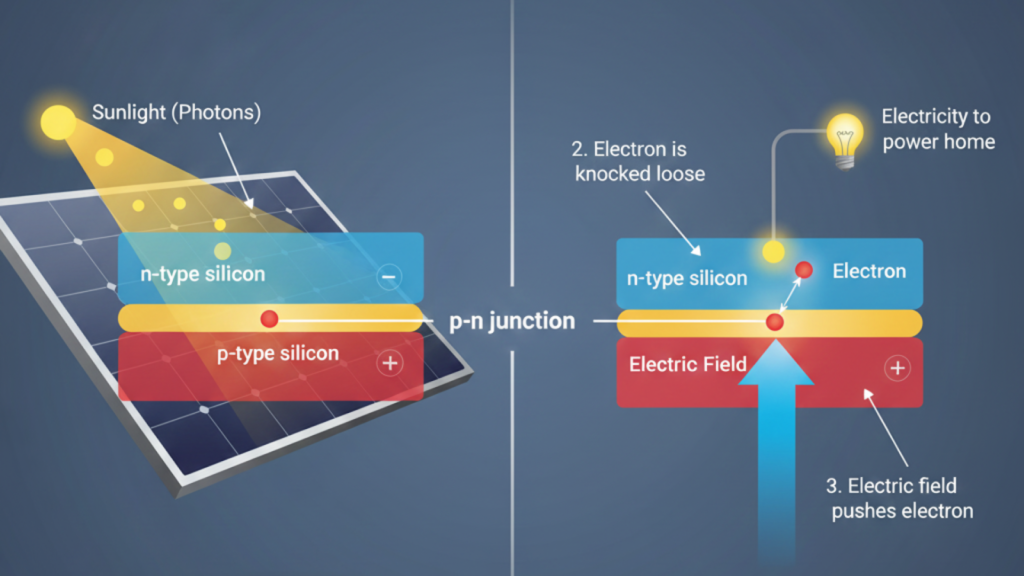
Before diving into the steps, it’s crucial to understand the scientific principle that makes solar power possible: the Photovoltaic (PV) Effect.
A solar panel contains many individual solar cells. These cells use silicon, a semiconductor material. Each cell features two layers: a p-type (positive) and an n-type (negative) layer. They create an electric field across a junction.
When photons (particles of light) from the sun strike the silicon cell, they transfer their energy to electrons in the silicon atoms. If a photon has enough energy, it knocks an electron loose. The electric field at the p-n junction acts like a one-way street, pushing the freed, negatively-charged electrons toward the n-type layer and the positively-charged ‘holes’ (where the electrons used to be) toward the p-type layer. This directed movement of electrons is the very beginning of electricity generation.
The 5-Step Guide: How is Solar Power Converted to Electricity?
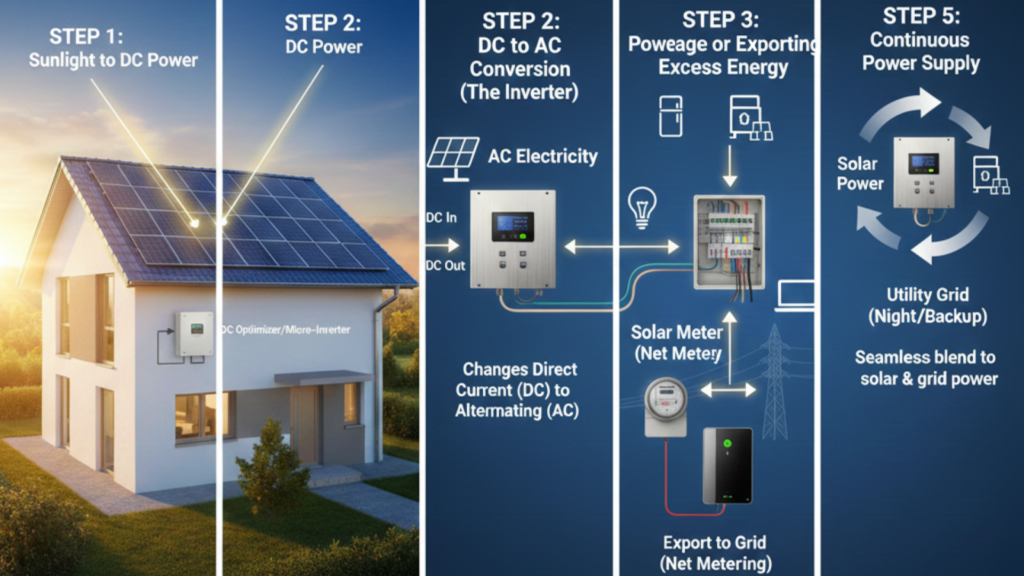
The complete process of converting sunlight into usable electricity for your home involves five distinct stages, transitioning the energy from light to the final, ready-to-use form.
Step 1: Sunlight Activation and DC Electricity Generation
The process begins the moment sunlight hits your rooftop solar panels.
- Photon Absorption: The PV cells absorb the photons, initiating the Photovoltaic Effect described above.
- Electron Flow: The cell’s internal electric field forces the freed electrons into a directional flow.
- Direct Current (DC) Output: This movement of electrons through the solar panel’s wiring creates an electrical current. Crucially, the electricity generated at this stage is Direct Current (DC), meaning the electrical charge flows in only one direction.
The amount of DC electricity produced depends on several factors, including the intensity of the sunlight (irradiance), the panel’s temperature, and the efficiency of the solar cell type.
| Solar Panel Type | Typical Efficiency Range (Commercial) | Key Characteristics |
| Monocrystalline | 15% – 22% (Some up to 25%+) | Highest efficiency; made from a single, pure silicon crystal; dark, uniform appearance. |
| Polycrystalline | 15% – 20% | Lower cost; made from fragments of silicon crystals; bluer, non-uniform appearance. |
| Thin-Film | 10% – 20% | Most flexible, lowest weight; lower efficiency per unit area; used in specialized applications. |
Step 2: The Inverter Converts DC to Usable AC Electricity
The direct current (DC) electricity generated by the panels is not compatible with most household appliances or the standard electrical grid. Your home operates on Alternating Current (AC) electricity, where the electrical charge periodically reverses direction.
This is where the solar inverter comes in, acting as the heart of your solar system.
- Conversion: The inverter takes the raw DC power from the panels and uses sophisticated electronics to transform it into AC power. This conversion is essential for making the electricity usable within your home.
- Monitoring & Optimization: Modern inverters also play a vital role in monitoring the system’s performance and optimizing power output, sometimes using Maximum Power Point Tracking (MPPT) technology to ensure panels are always generating at their peak capacity.
- Types of Inverters: Systems typically use string inverters, micro-inverters (one per panel), or power optimizers, depending on the system design and property needs.
Step 3: Distribution through the Electrical Panel
The inverter delivers the safe, usable AC electricity. It flows directly to your home’s main electrical panel (breaker box).
- Prioritization: Your solar system’s AC electricity is used first. It powers all running appliances and devices. This includes lights, the refrigerator, and the AC unit.
- Load Balancing: The electrical panel distributes the solar electricity across the various circuits of your home, effectively reducing the amount of power you need to draw from your utility company.
Step 4: Storage or Exporting Excess Energy (Net Metering)
On a sunny day, your solar system might generate more electricity than your home consumes immediately. At this stage, you have two primary options for handling the surplus energy: storage or exporting.
Option A: Battery Storage
If you have a solar battery storage system installed, the excess AC electricity can be routed to charge the battery bank. This stored energy can then be used later, such as at night or during a power outage, giving you energy independence.
Option B: Exporting to the Grid (Net Metering)
In most grid-tied systems, you send unused excess electricity back to the public utility grid.
- Net Metering: A crucial piece of equipment, the net meter, tracks the flow of electricity in both directions: the power you pull from the grid and the excess solar power you send back.
- Credits: Utility companies usually credit you for the power you export. This system is called net metering. It can significantly reduce or eliminate your monthly electricity bill.
Step 5: Powering Your Home and Drawing from the Grid
The final step represents the integrated operation of your solar system and the traditional utility grid.
- Daytime Operation: Your solar panels power your home during peak sunlight (Steps 1, 2, and 3). You store or export any surplus (Step 4).
- Nighttime/Cloudy Day Operation: The panels produce insufficient power at night, on cloudy days, or during high usage. Your home automatically and seamlessly draws power from the utility grid. The net meter keeps track of this consumption.
This continuous, automatic balance between solar generation and grid consumption is what makes a modern residential solar PV system so reliable and effective.
Key Components of a Home Solar System
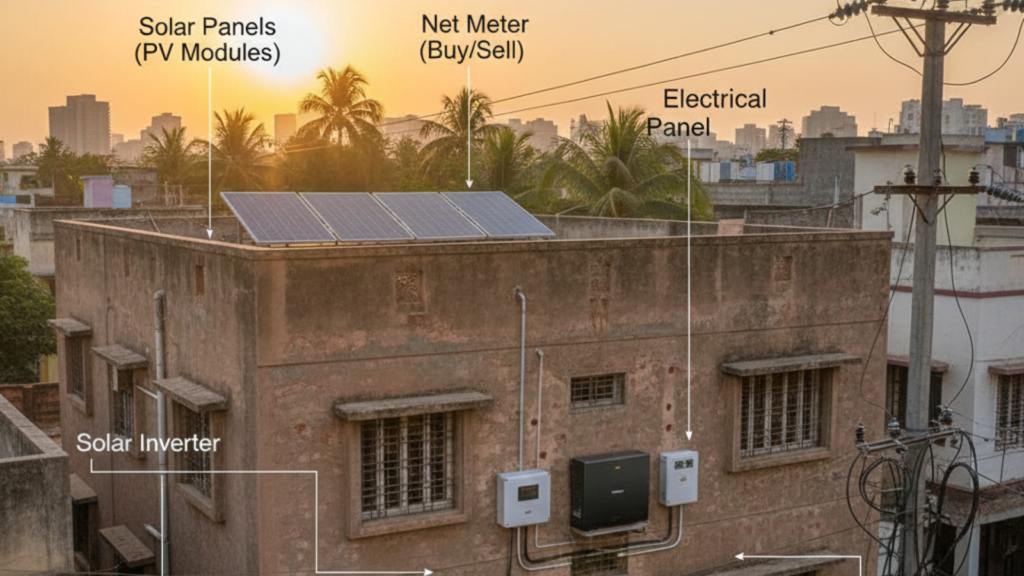
A complete solar installation uses more than just panels. It is a fully integrated system. These components work together to ensure safe and efficient conversion.
| Component | Function in the Conversion Process |
| Solar Panels (PV Modules) | The primary component. They absorb sunlight and generate Direct Current (DC) electricity via the Photovoltaic Effect. |
| Inverter (String, Micro, or Hybrid) | Converts the DC electricity from the panels into Alternating Current (AC) electricity, which is usable by household appliances and the grid. |
| Racking/Mounting System | Securely fastens the solar panels to the rooftop or ground, often optimizing the angle for maximum sunlight absorption. |
| Electrical Panel (Breaker Box) | Distributes the converted AC electricity throughout the home’s circuits for immediate use. |
| Net Meter | A bidirectional meter installed by the utility company to measure the electricity flowing into your home (from the grid) and the excess electricity flowing out of your home (to the grid). |
| Solar Battery (Optional) | Stores excess DC or AC electricity for use later, such as at night or during power outages. |
| Disconnects | Safety switches (AC and DC) required by code to quickly and safely shut down the electrical flow of the system during maintenance or emergencies. |
How is Solar Power Converted to Electricity? A Deep Dive into Efficiency and Performance

The solar conversion process is not 100% efficient; some of the incoming solar energy is lost as heat or reflected light. Understanding efficiency is key to appreciating the technology.
Efficiency in Solar Panels:
Solar panel efficiency refers to the percentage of sunlight energy that is converted into usable electricity. While commercial panel efficiencies typically range from 15% to over 25% for high-end models, the actual electricity output is influenced by several external factors:
- Temperature: PV cells perform better at cooler temperatures. High heat can decrease efficiency.
- Shading: Even partial shading on one panel can significantly cut system output. (Micro-inverters or optimizers help mitigate this).
- Angle and Orientation: Install panels at an optimal tilt and orientation. (Usually South in the Northern Hemisphere). This ensures they capture maximum sunlight all year.
- Component Quality: High-quality inverters and panels ensure minimal power loss during the conversion and transfer stages.
The continuous innovation in solar technology, including Perovskite cells and high-efficiency N-type silicon, is steadily pushing commercial efficiency limits, making solar power an increasingly powerful and cost-effective energy solution for homeowners. The future promises even more efficient ways to answer the question: How is solar power converted to electricity?
Conclusion: Harnessing the Sun — Understanding How is Solar Power Converted to Electricity
The process of converting solar power to electricity for your home is an elegant blend of physics and engineering. It starts with the Photovoltaic Effect in silicon cells, transforms into usable AC power via the inverter, and then integrates seamlessly into your home’s existing electrical system.
By installing a solar PV system, you are not just generating electricity; you are actively participating in the transition to sustainable energy, securing energy independence, and dramatically reducing your monthly utility costs. Understanding the 5-step process ensures you appreciate the powerful technology that is working quietly on your roof every day.
FAQ (Frequently Asked Questions) on How is Solar Power Converted to Electricity
Q1: What is the single most important component in the solar power conversion process?
The solar inverter is the most important component. Panels generate raw DC electricity. The inverter is the critical device. It converts that DC power into AC electricity. AC power is needed for home appliances and the grid. Without the inverter, the DC power is unusable for home consumption.
Q2: Do solar panels work at night?
No, solar panels do not generate electricity at night. The photovoltaic effect needs light (photons) from the sun. However, your home can still use solar energy at night. This happens if you have a solar battery to discharge stored energy. Alternatively, you rely on credits from net metering with the utility company.
Q3: How efficient are modern residential solar panels?
The efficiency of commercially available residential solar panels typically ranges from 15% to over 25%. High-end monocrystalline panels are generally the most efficient. This figure means that the panel converts that percentage of the available solar energy (sunlight) hitting its surface into usable electricity.
Q4: What happens to the excess electricity generated by my solar panels?
Excess electricity that is not immediately used is handled in two ways. It is either stored in a solar battery (if installed). Or, it is exported back to the utility grid through net metering. When exported, the utility company credits you for the power. This offsets the cost of grid electricity you draw later.
Q5: Will my solar power system work during a power outage?
Most standard grid-tied solar systems (without batteries) shut down during a power outage. This is for safety. It prevents dangerous ‘back-feeding’ onto utility lines. If you need backup power during an outage, you must install a solar battery storage system.
