
Transitioning to renewable energy is one of the smartest investments a homeowner can make. However, before you calculate your savings or choose a battery backup, you face a critical physical constraint: your roof. The most common question homeowners ask during the planning phase is simple yet crucial: How much roof space is needed for solar panels?
This guide will walk you through everything you need to know about sizing your solar array, measuring your roof, and ensuring your home is ready for clean energy
Why Accurate Sizing Matters for Your Solar Investment
Installing solar panels isn’t just about slapping photovoltaic cells onto shingles. It is a precise engineering challenge that balances your energy consumption with the physical real estate available on top of your house.
If you underestimate the space required, you may end up with a system that doesn’t offset your electricity bill enough to be worth the investment. Conversely, overestimating might lead you to believe solar isn’t an option for your home when high-efficiency panels could actually solve your space issues.
To answer how much roof space is needed for solar panels, we must first look at the variables: your energy usage, the efficiency of the panels, and the physical obstacles on your roof.
How Much Roof Space Is Needed for Solar Panels? (The General Rule)
Let’s get straight to the numbers. While every home is different, industry standards provide us with reliable averages.
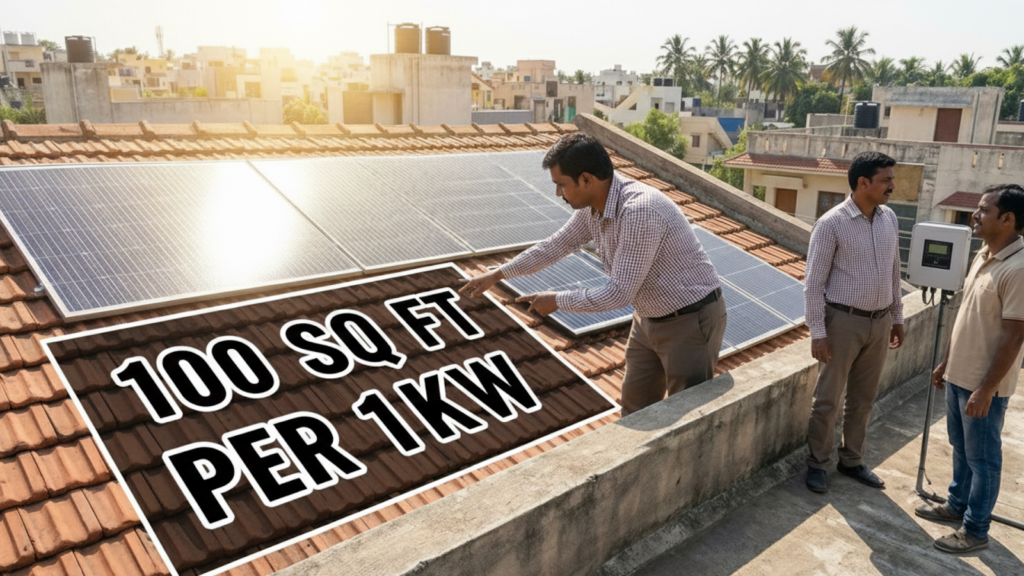
Generally, for every 1 kilowatt (kW) of solar capacity, you need approximately 60 to 75 square feet of roof space.
Most residential solar panels used today are around 17.5 square feet (roughly 5.5 feet tall by 3.25 feet wide). Therefore, a standard residential system usually falls between the 3kW and 10kW range.
The “100 Square Feet” Benchmark
A safe rule of thumb for planning is to allocate 100 square feet of roof space for every 1kW of system size. This extra buffer accounts for:
- Spacing between panels (for wiring and mounting clamps).
- Mounting rails.
- Fire safety setbacks (required clear pathways for firefighters).
Pro Tip: Never measure your roof’s total area and assume it is all usable. Shadows from trees, chimneys, and vents significantly reduce the “solar-viable” area.
Table 1: Estimated Area and How Much Roof Space Is Needed for Solar Panels by System Size
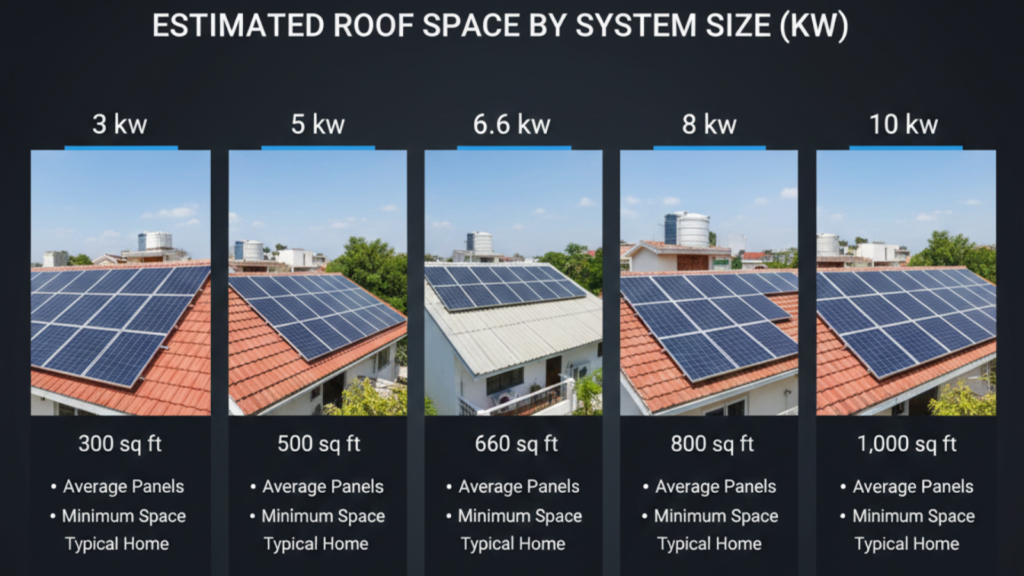
The following table breaks down how much roof space is needed for solar panels based on common system sizes. These calculations assume standard residential panels (approx. 370W – 400W).
| System Size (kW) | Average Number of Panels | Minimum Roof Space (Sq Ft) | Recommended Roof Space (Sq Ft) | Typical Home Suitability |
| 3 kW | 8 – 10 | 175 sq ft | 300 sq ft | Small home / Low usage |
| 5 kW | 13 – 16 | 290 sq ft | 500 sq ft | Average 2-bedroom home |
| 6.6 kW | 17 – 20 | 380 sq ft | 660 sq ft | Average family home |
| 8 kW | 20 – 24 | 460 sq ft | 800 sq ft | Large family / Pool owners |
| 10 kW | 25 – 30 | 580 sq ft | 1,000 sq ft | High usage / EV charging |
| 12 kW+ | 32+ | 700+ sq ft | 1,200+ sq ft | Large estates / Commercial |
Note: The “Recommended Roof Space” column includes necessary buffers for fire codes and roof obstacles.
Key Factors That Determine How Much Roof Space Is Needed for Solar Panels
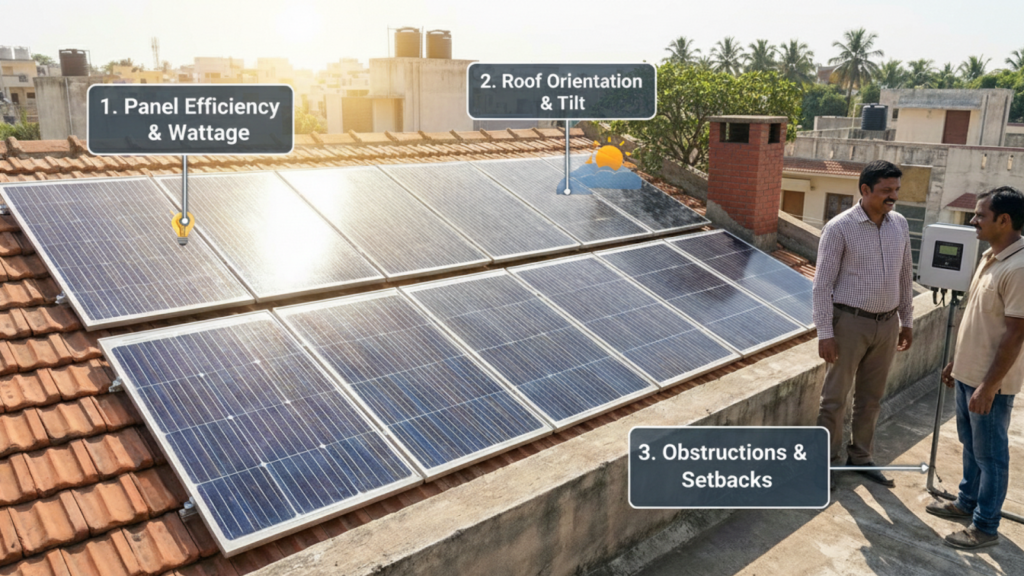
If you find yourself tight on space, you aren’t necessarily out of luck. The physical footprint of your solar array depends heavily on the technology you choose.
1. How Panel Efficiency Impacts How Much Roof Space Is Needed for Solar Panels
Not all panels are created equal.
- Standard Panels (Poly-crystalline): These are cheaper but less efficient. You will need more of them to generate the same amount of power, meaning they take up more roof space.
- High-Efficiency Panels (Mono-crystalline): These panels generate more power per square foot. If you have a small roof, high-efficiency panels are the best way to maximize output in a limited area.
2. Roof Orientation and Tilt Importance
South-facing roofs (in the Northern Hemisphere) are ideal. If your roof faces East or West, the panels will produce less electricity during peak hours. To compensate for this lower production, you may need to install more panels to hit your energy goals, effectively increasing the roof space required.
3. Understanding Obstructions and Roof Setbacks
When calculating how much roof space is needed for solar panels, you must subtract areas with:
- Chimneys
- Skylights
- Plumbing vents
- HVAC units
- Shaded areas from nearby trees
Furthermore, local building codes usually require a 3-foot clearance (setback) around the edges of the roof and the ridge for firefighter access.
Step-by-Step Guide: Calculating How Much Roof Space Is Needed for Solar Panels
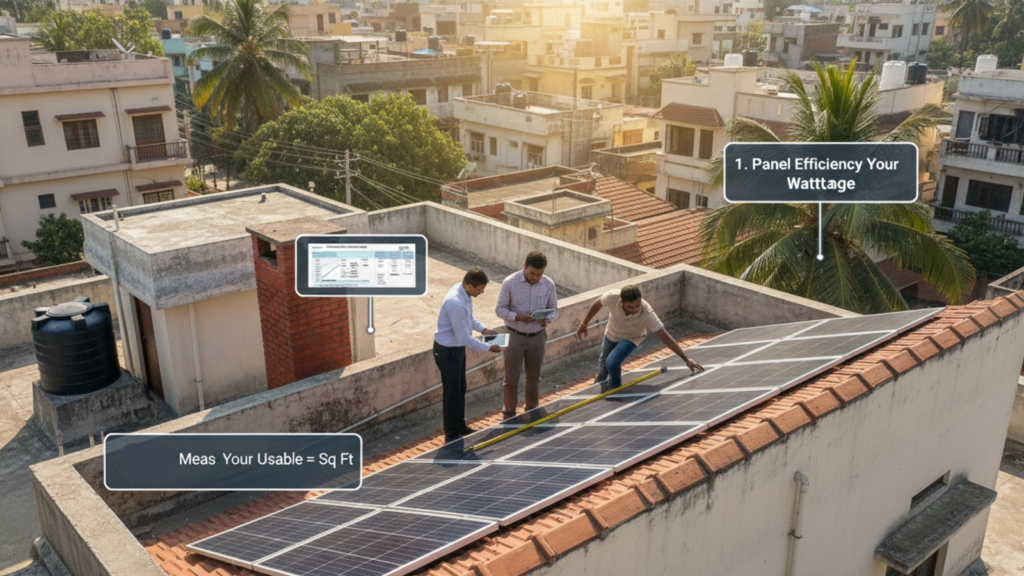
Follow this simple process to get a personalized estimate for your home.
Step 1: Determine Your Energy Needs (kWh)
Look at your electricity bill. Find your average monthly usage in kilowatt-hours (kWh). The average US home uses about 900 kWh per month. To offset this completely, you generally need a 6kW to 8kW system.
Step 2: Choose Your Panel Type (Standard vs. Premium)
Decide if you want standard panels or premium high-efficiency panels. This decision will dictate the “power density” of your roof.
Step 3: Apply the Space Calculation Formula
Use this formula to estimate your specific requirement:
Target System Size (kW) x 75 = Estimated Square Footage Needed
Example: If you need a 6kW system: 6 x 75 = 450 sq ft.
Step 4: Measure Your Usable Roof Area
You can use tools like Google Project Sunroof or physically measure your roof. Remember to subtract the “setbacks” (edges of the roof) and any obstruction zones.
Table 2: Panel Efficiency vs. Space Required
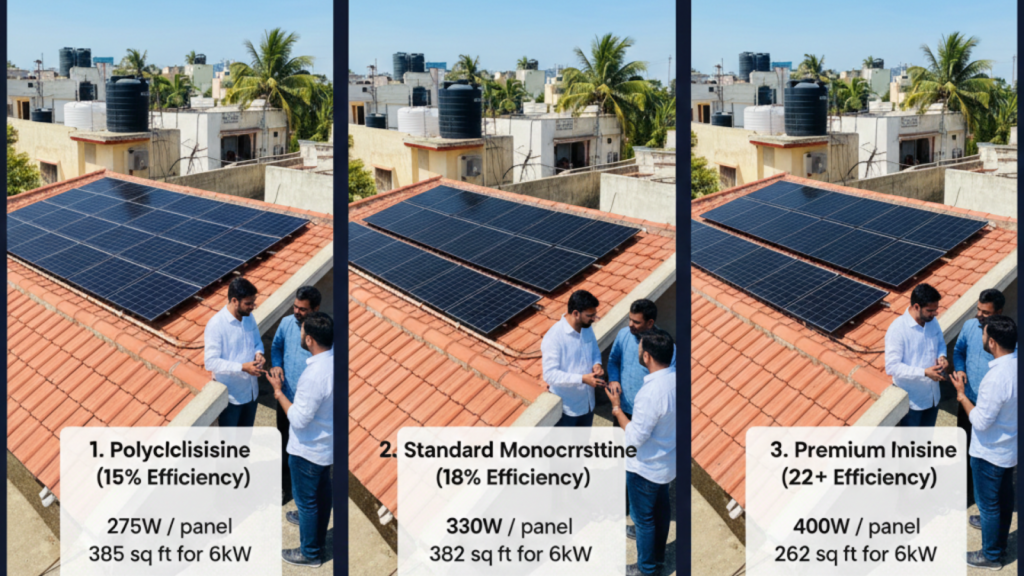
This table illustrates how upgrading to higher efficiency panels affects how much roof space is needed for solar panels to achieve a target of a 6kW System.
| Panel Technology | Efficiency Rating | Wattage Per Panel | Panels Needed for 6kW | Total Space Required (Approx) |
| Polycrystalline | 15% – 17% | 275W | ~22 Panels | 385 sq ft |
| Standard Monocrystalline | 17% – 19% | 330W | ~19 Panels | 332 sq ft |
| Premium Monocrystalline | 20% – 22%+ | 400W | ~15 Panels | 262 sq ft |
As you can see, using Premium Monocrystalline panels can save over 100 square feet of roof space compared to older Polycrystalline technology.
Strategies for Small Roofs: What If You Don’t Have Enough Space?
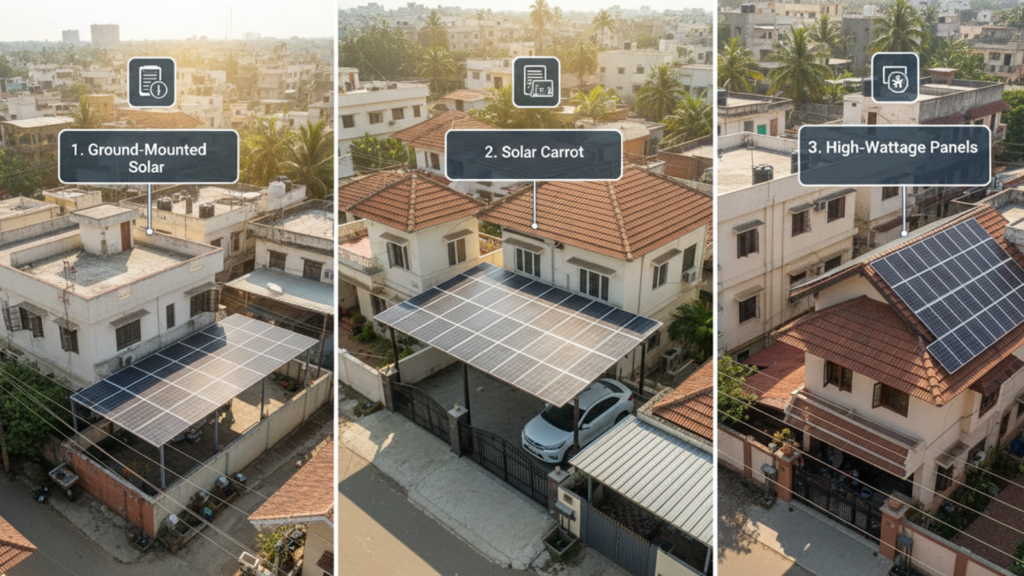
If your calculation for how much roof space is needed for solar panels exceeds what you actually have, consider these solutions:
Ground-Mounted Solar
If you have a large backyard, a ground-mounted system is an excellent alternative. It allows you to position panels at the perfect angle and orientation without being limited by roof design.
High-Wattage Panels for Maximum Output
Invest in 400W+ panels. While the upfront cost is higher, the ability to generate maximum power in a minimal footprint often pays for itself over time.
Solar Carports or Pergolas
Building a solar structure over a driveway or patio can add functional space to your property while providing the necessary square footage for energy generation.
Conclusion: Final Thoughts on Solar Sizing
Understanding how much roof space is needed for solar panels is the foundational step of your solar journey. While the general rule is about 75 to 100 square feet per kilowatt of energy, the specific geometry of your roof and the efficiency of the panels you choose will dictate the final layout.
Don’t let a smaller roof discourage you. With modern high-efficiency panels, even compact urban roofs can generate significant power. The key is accurate measurement and realistic energy goals. By planning carefully and accounting for obstructions and setbacks, you can design a system that maximizes every inch of available sunlight.
Frequently Asked Questions (FAQ) About Solar Roof Space
1. How much roof space is needed for solar panels to power a typical house?
A typical home usually needs a 6kW to 8kW system. Therefore, you will generally require 400 to 600 square feet of usable and unshaded roof space. Moreover, high-efficiency panels can reduce this requirement slightly.
2. Can I install solar panels on a flat roof?
Yes, you can install solar panels on a flat roof. In fact, flat roofs are excellent for solar because racking systems allow the panels to tilt perfectly toward the sun. However, because tilted panels create shadows on the rows behind them, you may need extra spacing, which increases the total roof area required.
3. Does the shape of my roof affect how much space I need?
Yes, the shape of your roof affects the available space. A simple rectangular roof is the most efficient because it allows panels to be arranged neatly. However, roofs with hips, valleys, dormers, or complex angles break up the layout. As a result, you might need more total roof area to fit the same number of panels.
4. What is the minimum roof space required for solar?
Technically, you can install only one or two panels if you prefer. However, for a practical grid-tied system, installers generally recommend a minimum of 2kW to 3kW, which usually needs 150 to 200 square feet of usable roof area. Additionally, choosing high-wattage panels can reduce the space requirement.
5. How much weight do solar panels add to the roof?
Solar panels typically add 2.5 to 3 pounds per square foot. This is well within the capacity of most modern roofs. However, a structural assessment is always included in professional installations to ensure your roof can safely support the added load.
