
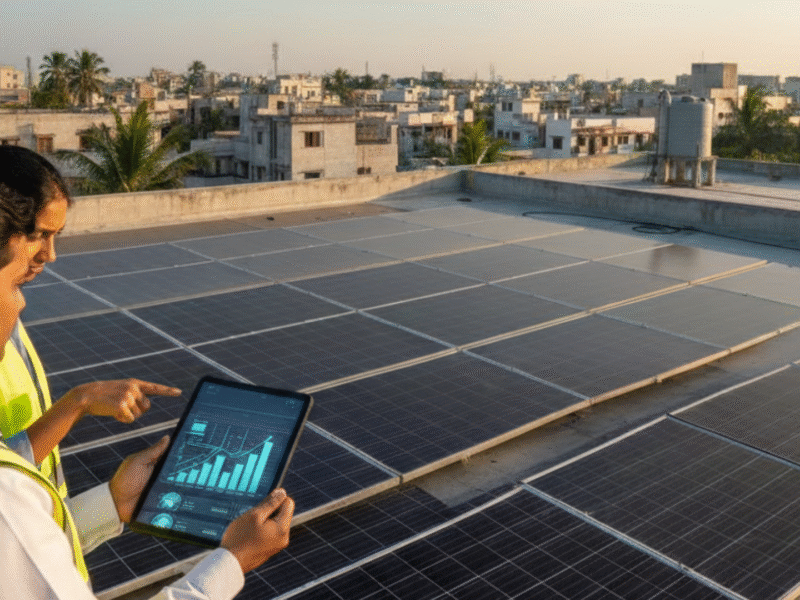
Going solar is not just an environmental choice; it’s a major financial decision. In 2025, the solar market in India is more competitive and transparent than ever, but understanding the true solar panel price per watt in India is crucial before investing.
This comprehensive guide breaks down the per-watt cost, analyzes the factors that cause price variations, and provides a clear buyer’s guide, ensuring you get the best Return on Investment (ROI) from your solar installation.
1. The Current Solar Panel Price Per Watt in India (2025)
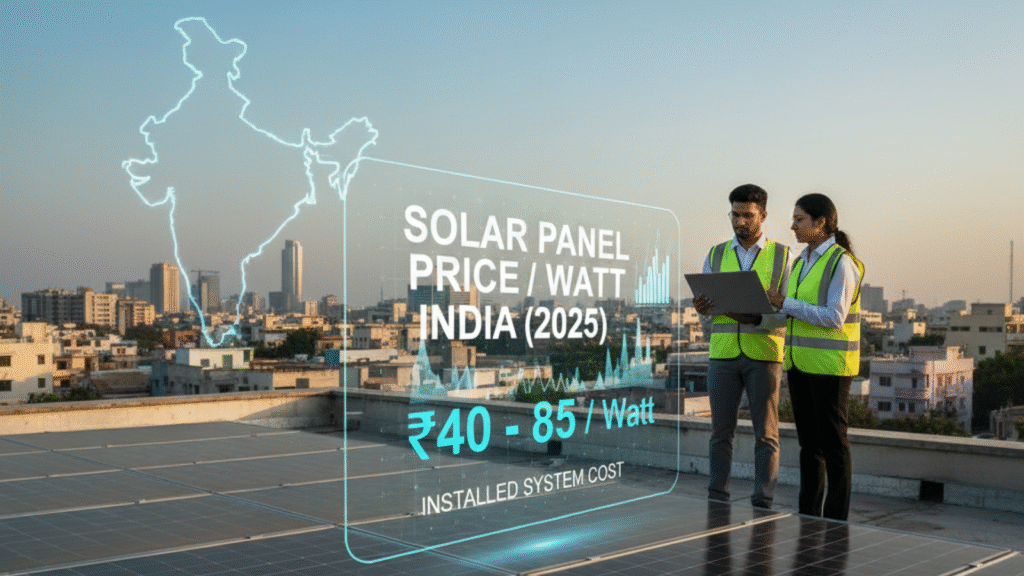
The price per watt is the gold standard metric for comparing solar system costs. It normalizes the price across different system sizes (measured in kilowatts, or kW), giving you a clear, apples-to-apples comparison.
In 2025, the average installed price for a residential rooftop solar system (including panels, inverter, mounting, and installation) in India ranges from ₹40 to ₹85 per watt before subsidy.
Table 1: Complete Solar System Price Per Watt by System Size (Residential, Before Subsidy)
While the cost per watt of the panel itself is lower, the true investment is the installed system cost per watt. As you increase the system size (kW), the price per watt generally decreases due to economies of scale.
| System Size (kW) | Average Total Cost Range (₹) | Price Per Watt Range (₹) | Ideal For |
| 1 kW | ₹65,000 – ₹85,000 | ₹65 – ₹85 | Small homes, 1-2 BHK, basic appliances. |
| 3 kW | ₹1,65,000 – ₹2,15,000 | ₹55 – ₹71 | Medium homes, 3-4 BHK, use of AC/Geyser. |
| 5 kW | ₹2,75,000 – ₹3,55,000 | ₹55 – ₹71 | Large homes/Duplexes, multiple ACs, high usage. |
| 10 kW | ₹5,50,000 – ₹6,50,000 | ₹55 – ₹65 | Villas, large independent homes, or small commercial units. |
Note: Prices are estimates for a standard on-grid system using Mono PERC panels. Actual costs depend heavily on the factors detailed in Section 3.
2. Solar Panel Price Per Watt Based on Panel Technology
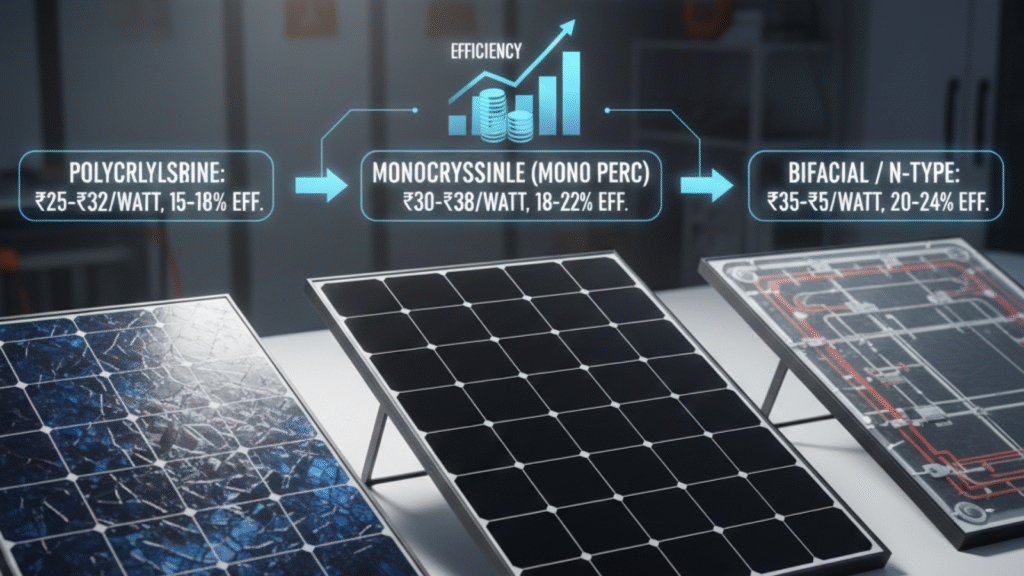
The single biggest factor determining the raw price of the panel itself is the technology and efficiency. More advanced panels offer a higher output from a smaller area, but come at a higher solar panel price per watt in India.
| Panel Type | Efficiency Range | Approximate Price Per Watt (₹) | Key Feature |
| Polycrystalline (Poly) | 15% – 18% | ₹25 – ₹32 | Budget-friendly, standard blue colour, lower space efficiency. |
| Monocrystalline (Mono PERC) | 18% – 22% | ₹30 – ₹38 | High efficiency, sleek black aesthetic, excellent for small roof space. |
| Bifacial / N-Type | 20% – 24% | ₹35 – ₹45 | Premium efficiency, generates power from both sides (front and back). |
For most residential users with limited rooftop space, the Monocrystalline (Mono PERC) panels strike the best balance between efficiency, durability, and a reasonable price per watt.
3. Factors That Define the Final Solar Panel Price Per Watt
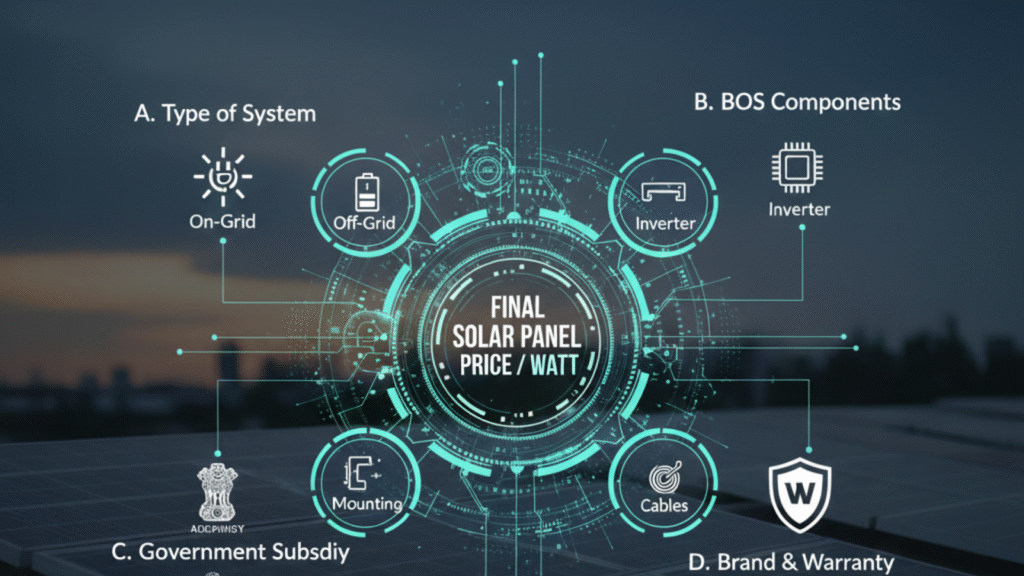
The final cost you pay is not just the sum of the panels; it’s a comprehensive system cost. Several major factors influence the final solar panel price per watt in India:
A. The Type of Solar System (On-Grid vs. Off-Grid)
- On-Grid (Grid-Tied): This is the cheapest option. It connects to the utility grid and uses a standard inverter. The price per watt is the lowest because there are no expensive battery costs.
- Off-Grid (Battery Backup): This system uses a battery bank for backup power during outages. The cost of Lithium-Ion or Lead-Acid batteries can add 30% to 50% to the overall price, significantly increasing the final price per watt.
- Hybrid: A mix of both, offering grid connectivity plus battery backup. This is the most flexible but also the most expensive option.
B. Balance of System (BOS) Components
BOS accounts for approximately 30-40% of the total project cost. The quality of these items directly impacts your final solar panel price per watt:
- Inverter Quality: String inverters are cheaper than Micro-inverters. Choosing a premium brand inverter (like SolarEdge or Fronius) can increase the per-watt cost but guarantees higher conversion efficiency and a longer life.
- Mounting Structure: A standard fixed tilt structure is inexpensive. Custom, elevated, or ground-mounted structures—especially those required for irregular or shaded roofs—will push the per-watt price higher due to increased material and labour costs.
- Cables and Wiring: Using high-quality, thick copper DC cables ensures minimal power loss but contributes to a slightly higher initial investment.
C. Government Subsidy & Incentives (PM Surya Ghar Yojana)
The Central Financial Assistance (CFA) offered by the Government of India under the PM Surya Ghar: Muft Bijli Yojana is the most significant factor in reducing your final cost.
The subsidy is calculated on the benchmark cost of the system and is designed to drastically lower the homeowner’s upfront cost, making the effective solar panel price per watt in India extremely affordable.
- For 1 kW to 3 kW Systems: You receive a substantial subsidy on the benchmark cost.
- For Systems Above 3 kW: A fixed subsidy amount is generally applicable up to a total capacity limit (usually 10 kW).
This subsidy must be factored in to determine the final, out-of-pocket price per watt.
D. Brand and Warranty
Premium international and domestic brands like Tata Power Solar, Waaree, Adani Solar, and Loom Solar generally have a higher raw price per watt for their panels. This premium is justified by:
- Higher Efficiency: They often use superior cell technology (like N-Type or TOPCon).
- Longer Warranty: They usually offer a 25-year performance warranty and a 12-year product warranty.
- Reliability: The higher brand cost is an investment in guaranteed performance and peace of mind.
4. Total Investment Calculation: Price Per Watt vs. Lifetime Savings

When evaluating the solar panel price per watt in India, it is vital to shift your focus from the initial cost to the long-term return on investment (ROI).
A. Calculating Your Payback Period
The payback period is the time it takes for your electricity bill savings to equal the initial investment cost.
Payback Period (Years) = Total Installed System Cost (₹) / Average Annual Electricity Bill Savings (₹)
Due to decreasing system costs and high state electricity tariffs (which often increase annually), the payback period for a residential system in India is generally between 4 to 6 years. This is one of the fastest payback times globally.
B. Projected Lifetime Savings
A high-quality solar system has a life expectancy of 25 years or more. A simple 5 kW system can generate approximately 7,000 to 8,000 units of electricity annually. Over its 25-year lifetime, the total savings—including protection from future tariff hikes—can amount to ₹15 Lakhs to ₹20 Lakhs.
Even if you pay a slightly higher price per watt for a premium system, the increased efficiency and reliability can lead to significantly higher generation and savings over 25 years, resulting in a better ROI.
Conclusion: Making the Smart Solar Investment
The solar panel price per watt in India in 2025 is remarkably low, making this the ideal time to invest in solar energy. Whether the raw panel price is ₹30 or ₹40 per watt, the final system cost (₹40 to ₹85 per watt installed) offers an unparalleled return.
Your focus should be on system sizing, panel efficiency (Mono PERC is recommended), and maximizing the government subsidy. By obtaining detailed quotes from certified installers, comparing the final post-subsidy price per watt, and focusing on long-term performance, you can ensure a successful and highly profitable solar journey.
Frequently Asked Questions (FAQ)
Q1. What is the average price of a 3kW solar panel system in India?
A. The average price for a complete 3 kW residential on-grid solar system in India is generally between ₹1,65,000 and ₹2,15,000 before subsidy. After applying the central government subsidy (under the PM Surya Ghar Yojana), the net cost can fall significantly, often coming down to between ₹90,000 and ₹1,30,000, depending on your system’s benchmark cost and state-specific incentives.
Q2. Does the Solar Panel Price Per Watt in India include installation?
A. The raw panel cost (e.g., ₹35/watt) only covers the PV module itself. The installed solar panel price per watt (e.g., ₹55 – ₹85/watt) is the key figure for a buyer. This includes the cost of the solar panels, inverter, mounting structure, wires, labour, and all other Balance of System (BOS) components. Always ask for the total installed system price per watt.
Q3. How much roof space is required for a 1 kW solar system?
A. On average, a 1 kW solar system requires approximately 80 to 100 square feet (sq. ft.) of shadow-free rooftop space. This space requirement depends on the panel efficiency; higher-efficiency panels (Mono PERC) require less space than Polycrystalline panels.
Q4. Which type of solar panel gives the best value for the price per watt?
A. Monocrystalline PERC (Mono PERC) panels generally offer the best value. While their per-watt price is slightly higher than Polycrystalline, their superior efficiency (18-22%) means you need fewer panels to achieve your target capacity (kW), saving roof space and often resulting in a better overall system output and faster ROI.
Q5. Is there a government subsidy for solar panels in 2025?
A. Yes. The Government of India provides significant subsidies under the PM Surya Ghar: Muft Bijli Yojana for residential rooftop solar installations. The subsidy can cover a large portion of the cost, making solar highly accessible. It is crucial to apply through the National Portal for Rooftop Solar to avail of this benefit.
