

In the rapidly evolving Indian real estate market, sustainability has transitioned from a niche preference to a core demand. With electricity tariffs rising in states like Maharashtra, Karnataka, and Delhi, and the government pushing for green energy through initiatives like the PM Surya Ghar: Muft Bijli Yojana, a critical question arises for homeowners: Does solar increase property value?
The answer, backed by emerging market trends in India, is yes.
Recent data from renewable energy consultants and real estate insights suggests that homes with functional rooftop solar systems command a premium of 3% to 5% over non-solar properties. Furthermore, these homes often sell 15-20% faster because buyers are attracted to the promise of “zero electricity bills” from day one.
This comprehensive guide serves as the ultimate homeowner’s resource, breaking down the financial benefits, Return on Investment (ROI), and the real estate dynamics of solar energy in India.
Why Does Solar Increase Property Value?
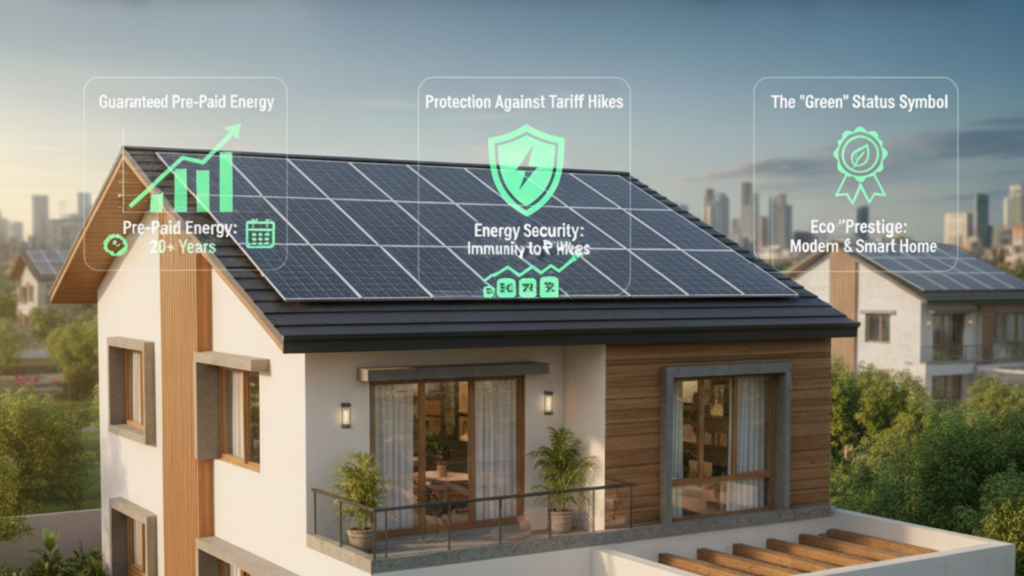
The “Solar Premium” in India is driven by tangible financial benefits and shifting buyer psychology. When a buyer looks at a home with a 3kW or 5kW solar plant, they see three distinct advantages:
- Guaranteed Pre-Paid Energy: A solar system effectively pre-pays for electricity for the next 20+ years. In a country where summer AC usage drives bills up to ₹5,000–₹10,000 per month, eliminating this cost is a massive financial incentive.
- Protection Against Tariff Hikes: Electricity rates in India historically rise by 2-5% annually. A solar home is immune to these hikes, offering “energy security.”
- The “Green” Status Symbol: In Tier-1 cities like Bengaluru, Pune, and Hyderabad, eco-friendly living is increasingly prestigious. A visible rooftop solar system signals a modern, forward-thinking home, attracting the educated middle-class buyer.
The Numbers: How Much Value Does It Add?
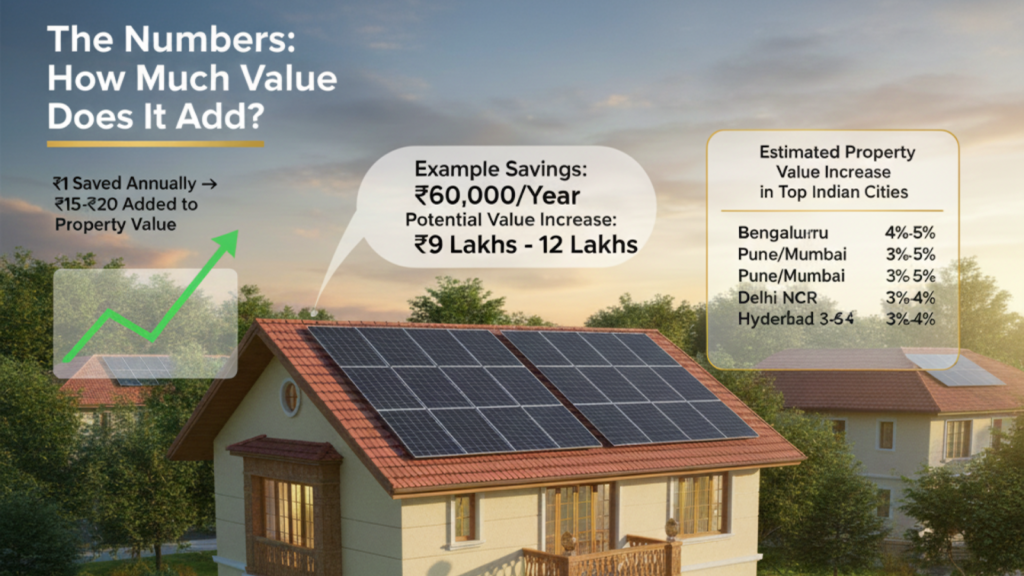
While exact figures vary by city, industry estimates suggest a clear correlation between energy savings and property value. A widely accepted rule of thumb in real estate valuation is that for every ₹1 saved in annual utility costs, the property value increases by roughly ₹15 to ₹20.
For example, if a solar system saves you ₹60,000 per year, it could theoretically add ₹9 Lakhs to ₹12 Lakhs to the home’s value over its lifetime, though immediate resale premiums are usually more conservative.
Table 1: Estimated Property Value Increase in Top Indian Cities
The impact of solar on property prices is highest in states with high electricity tariffs (like Maharashtra) or high environmental awareness (like Karnataka).
| City / Region | Avg. Resale Premium (%) | Est. Value Increase (on ₹80L Home) | Market Demand Level |
| Bengaluru (Karnataka) | ~4% – 5% | ₹3.2 Lakhs – ₹4.0 Lakhs | Very High |
| Pune / Mumbai (Maharashtra) | ~3% – 5% | ₹2.4 Lakhs – ₹4.0 Lakhs | Very High |
| Delhi NCR | ~3% – 4% | ₹2.4 Lakhs – ₹3.2 Lakhs | High |
| Hyderabad (Telangana) | ~3% – 4% | ₹2.4 Lakhs – ₹3.2 Lakhs | High |
| Chennai (Tamil Nadu) | ~2.5% – 3.5% | ₹2.0 Lakhs – ₹2.8 Lakhs | Moderate-High |
| Tier-2 Cities (Jaipur, Indore) | ~2% – 3% | ₹1.6 Lakhs – ₹2.4 Lakhs | Rising Rapidly |
Note: These percentages are estimates based on market trends for independent floors and villas. The “Green Premium” is currently higher in gated communities.
Critical Factor: CAPEX (Owned) vs. RESCO (Leased)
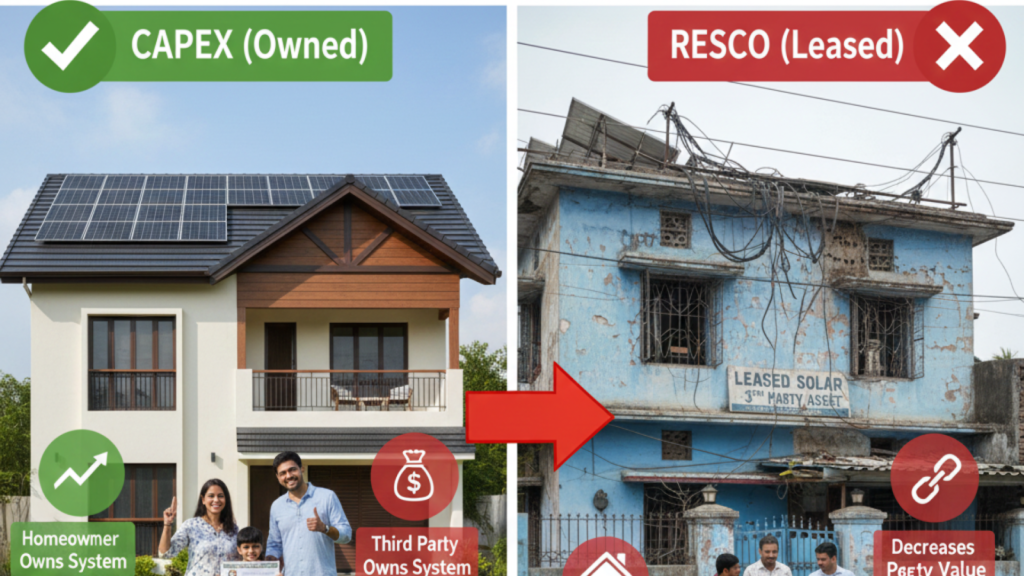
Just like in international markets, the ownership model of your solar panels dictates whether they add value to your house. In India, two primary models exist: CAPEX (Capital Expenditure – Self Owned) and RESCO (Renewable Energy Service Company – Third Party Owned).
Only CAPEX (Owned) systems consistently increase property value.
If you install solar under a RESCO model (where a company installs it for free and sells you the power), you do not own the equipment. When you sell your house, transferring this contract to a new buyer can be complicated and may even scare them away.
Table 2: ROI Analysis for a 5kW Solar System (Owned)
Is the increase in property value worth the initial cost? Let’s look at the numbers for a typical 5kW system in 2024-25 using the PM Surya Ghar subsidy scheme.
| Feature | Financial Impact (Estimated) |
| System Size | 5 kW (Sufficient for a 3-4 BHK with ACs) |
| Upfront Cost (Market Price) | ₹2.5 Lakhs – ₹3.0 Lakhs |
| Govt. Subsidy (PM Surya Ghar) | – ₹78,000 (Fixed for systems >3kW) |
| Net Cost to Homeowner | ₹1.72 Lakhs – ₹2.22 Lakhs |
| Annual Electricity Savings | ₹60,000 – ₹90,000 (approx. ₹6k/month) |
| Payback Period | 3 – 4 Years |
| Added Resale Value | ₹2.5 Lakhs – ₹3.5 Lakhs (Immediate) |
Key Takeaway: With the subsidy, a solar system pays for itself in savings within 4 years. If you sell the house immediately after installation, the value added (₹2.5L+) often exceeds the net cost (₹1.72L), giving you an instant profit.
Does Solar Increase Property Value in Every Indian Market?
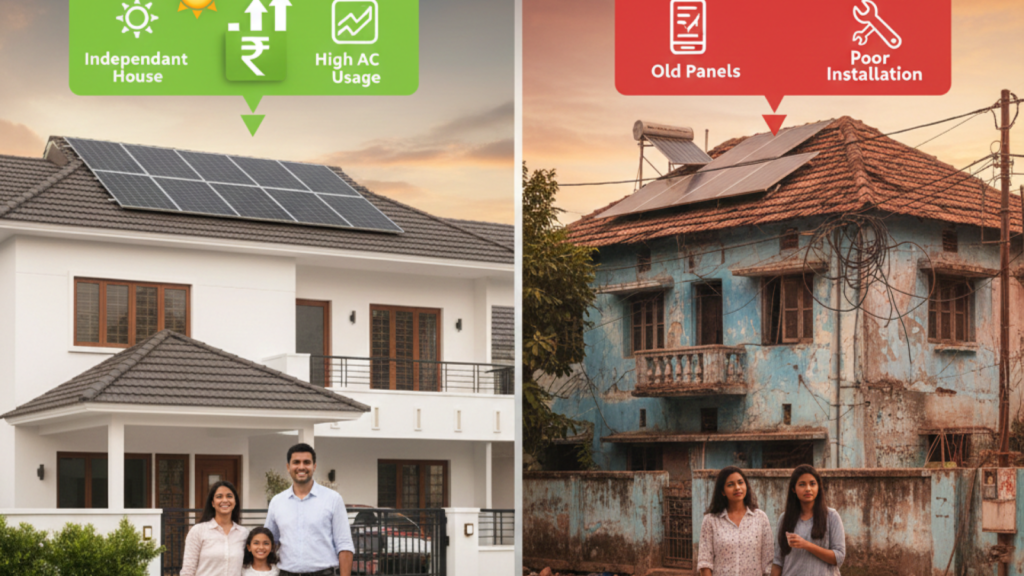
While the trend is positive, it is not universal. The value add depends on specific local factors:
When Solar Adds Maximum Value:
- Independent Houses & Villas: You own the roof, so the value is clear. In apartments, unless it is a private terrace installation, the value add is shared or negligible for the individual unit.
- High Consumption Households: Buyers looking for large homes (3BHK+) anticipate high bills. A solar system that offsets AC and Geyser usage is a massive selling point.
- Net-Metering Availability: Homes with an active “Net Meter” (which sends excess power back to the grid for credits) are worth more. It turns the home into a revenue-generating asset.
When Solar Adds Less Value:
- Poor Installation Quality: If the wiring is messy or the mounting structure looks rusted/unsafe, buyers may view it as a liability that needs repair.
Old Inverters: If the system is 10+ years old and the inverter warranty has expired, buyers might calculate the replacement cost (approx. ₹20k-40k) and deduct it from their offer.
Maximizing Your ROI: Tips for Indian Homeowners

To ensure your solar investment translates into higher property resale value:
- Preserve Paperwork: Keep the warranty cards, AMC (Annual Maintenance Contract) records, and the Net Metering approval letter from your DISCOM (e.g., BESCOM, TATA Power, JVVNL). These prove the system is legal and healthy.
- Opt for High-Efficiency Panels: Mono-PERC or Bifacial panels function better in low light and degradation is slower. Educated buyers know the difference between “Poly” (blue, older tech) and “Mono” (black, newer tech) panels.
- Transferability: Ensure your warranty allows transfer to a new owner. Most Tier-1 brands (like Waaree, Tata Solar, Adani) support this.
- Showcase the Savings: When listing your home, include a picture of a recent electricity bill showing “Zero” or a credit balance. This is powerful visual proof for buyers.
Conclusion: So, Does Solar Increase Property Value?
So, does solar increase property value in India? The evidence indicates a definite yes.
In a market increasingly sensitive to inflation and living costs, a home that generates its own electricity is a premium asset. With the government offering subsidies up to ₹78,000, the initial barrier to entry is low, while the exit value (resale price) is high—often adding 3-5% to your property’s worth.
For Indian homeowners, solar is no longer just an environmental charity; it is a strategic financial upgrade. It lowers your running costs today and boosts your asking price tomorrow.
Frequently Asked Questions About Solar and Property Value
Q1. Does installing solar increase my property tax in India?
Generally, no. Most municipal corporations in India do not increase property tax assessments based on rooftop solar installations. In fact, some cities (like those in recent green initiatives) have proposed or offered rebates on property tax for green buildings, though this varies strictly by municipality.
Q2. How do I transfer the solar system to the new buyer?
The physical system is sold as part of the house “fixtures.” However, you must transfer the Net Metering connection at the local electricity board office (DISCOM). This usually involves a simple name change application, similar to changing the name on the electricity bill itself.
Q3. Is it difficult to sell a house with solar panels in India?
On the contrary, real estate agents report that solar homes receive higher inquiries. The prospect of buying a house that is “future-ready” and insulated from power cuts (if hybrid) or high bills is a major attractor for modern families.
4. What if my solar panels are very old?
Solar panels typically have a performance warranty of 25 years. If your system is 10 years old, it still has 15 years of life left. However, you might need to replace the inverter. Being transparent about this and perhaps offering a small discount for a new inverter can keep the deal smooth.
5. Does the PM Surya Ghar subsidy transfer to the new owner?
No, the subsidy is a one-time benefit given to the person who installs the system. However, the value of that subsidy is passed on effectively because the new buyer gets a fully functioning power plant without having to go through the installation hassle or wait for subsidy approvals.
