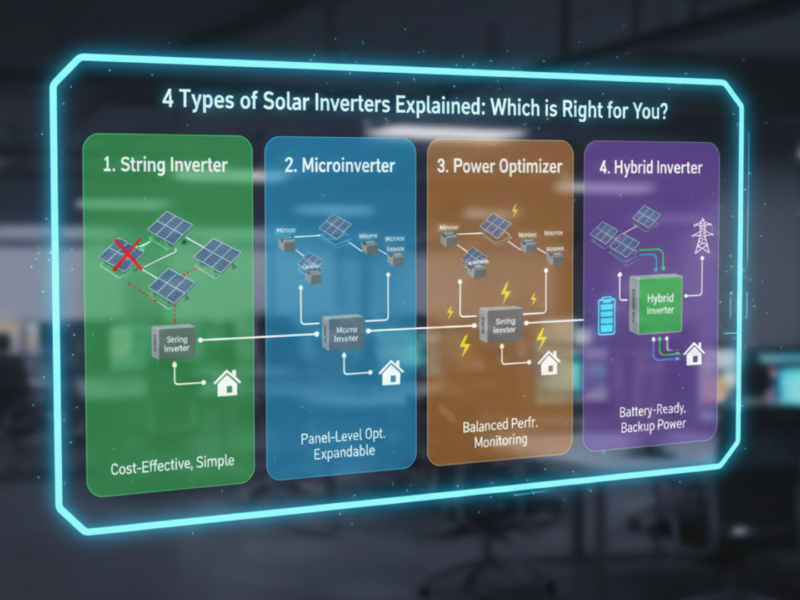
The transition to solar energy is one of the most impactful decisions a homeowner or business can make, and while the solar panels themselves often grab the spotlight, the solar inverter is arguably the most crucial component of any photovoltaic (PV) system. It’s the brain that transforms the raw electricity generated by your panels into the usable power that runs your home and can be fed back into the utility grid. The core function of all types of solar inverters is to convert the Direct Current (DC) electricity produced by solar panels into Alternating Current (AC) electricity, which is the standard power used by homes, businesses, and the electrical grid. However, not all inverters are created equal.
Choosing the right type of solar inverter is vital for maximizing your system’s efficiency, longevity, and overall return on investment (ROI). With advancements in solar technology, four primary types of solar inverters have emerged as market leaders. Understanding these distinct types will empower you to select the best fit for your unique roof layout, budget, and energy goals.
Understanding the 4 Main Types of Solar Inverters
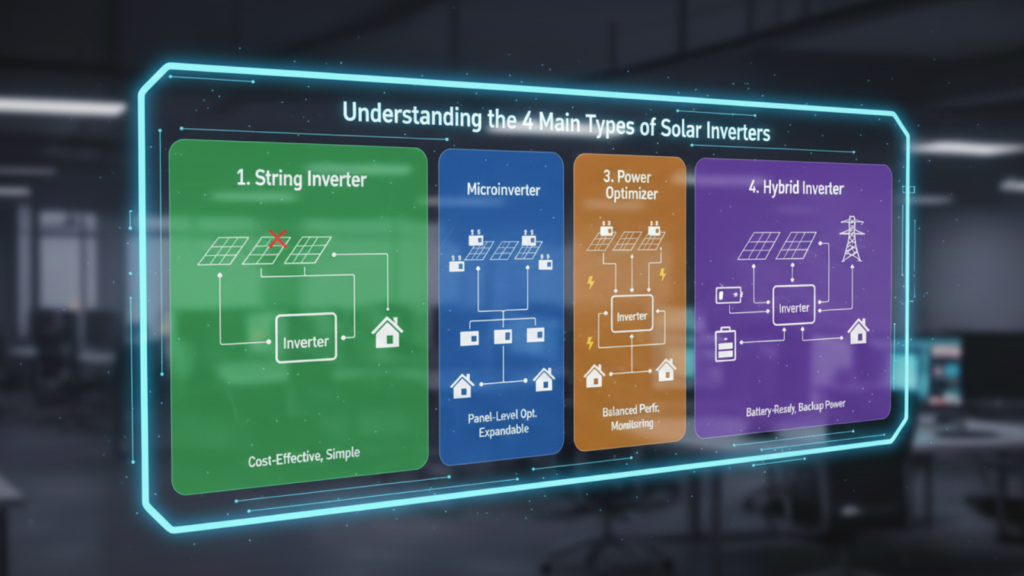
The four main types of solar inverters are String Inverters, Microinverters, Power Optimizers, and Hybrid Inverters. Each technology offers a different approach to power conversion and management.
1. String Inverters (Centralized Types of Solar Inverters)
String inverters are the most traditional and widely used type of inverter, especially in cost-sensitive installations with uniform, unshaded roofs.
How They Work
Solar panels are wired together in a series—forming a “string”—that connects to one central inverter unit, typically located on a wall outside your home or in a garage. The entire DC output from the string of panels is fed into this single inverter, which then performs the DC-to-AC conversion.
Key Features
- Centralized Conversion: All power conversion happens at one central point.
- Cost-Effectiveness: They are generally the most affordable option upfront for small to medium-sized systems.
- Simplicity: Installation is relatively straightforward, and troubleshooting is simpler as there’s only one large unit to check.
The “String Effect” Limitation
The main drawback of a string inverter system is the “string effect.” Since the panels are wired in series, the entire string’s performance is limited to that of the lowest-performing panel. If one panel is shaded by a tree branch, covered in dust, or slightly underperforming, the output of every other panel in that string drops to the same reduced level.
2. Microinverters (MLPE Types of Solar Inverters)
Microinverters represent the pinnacle of individual panel optimization, offering maximum energy harvest and system flexibility.
How They Work
Instead of one central inverter, a small, individual microinverter is installed directly underneath or adjacent to each solar panel (module). This allows the DC-to-AC conversion to happen right at the panel level.
Key Features
- Panel-Level Optimization: Because each panel operates independently, shading on one panel will not affect the output of any other panel. This maximizes overall system efficiency, especially in non-ideal conditions.
- Enhanced Monitoring: They provide detailed, real-time data on the performance of every single panel, making it easy to spot and diagnose issues.
- Scalability: Expanding your system in the future is simple—you just add a new panel with its own microinverter.
- Safety: The high-voltage DC power (which is a safety risk) is converted to low-voltage AC power immediately on the roof, reducing the risks associated with long DC wiring runs.
The Cost-Performance Trade-Off
While microinverters deliver superior performance in complex environments, they come with the highest initial equipment cost because you are purchasing multiple small inverters instead of one large one. Maintenance can also be more complex, as a technician may need to access the roof to replace a faulty unit.
3. Power Optimizers (MLPE)
Power Optimizers are a hybrid solution designed to bridge the gap between the cost-effectiveness of string inverters and the panel-level optimization of microinverters.
How They Work
Like microinverters, a power optimizer is installed beneath each solar panel. However, the optimizer does not perform the DC-to-AC conversion. Instead, it conditions, or “optimizes,” the DC output voltage of its panel and sends this optimized DC power to a single, central string inverter for the final DC-to-AC conversion.
Key Features
- Panel-Level MPPT: The optimizer performs Maximum Power Point Tracking (MPPT) for each panel, ensuring that even if one panel is shaded, its output doesn’t drag down the entire system.
- Centralized AC Conversion: The cost of the final AC conversion is kept low by using a single, string-like inverter.
- Monitoring and Safety: They offer panel-level monitoring and often include advanced safety features like rapid shutdown.
The Value Proposition
Power optimizers generally cost less than a full microinverter system but significantly outperform a basic string inverter in shaded or multi-orientation installations. They provide an excellent balance of cost, performance, and monitoring capabilities.
4. Hybrid Inverters (Battery-Ready)
A Hybrid Inverter is a specialized type of inverter designed for the growing demand for energy storage.
How They Work
A hybrid inverter functions as a standard string inverter by converting solar DC power into household AC power. However, it also incorporates a battery charge controller. This dual functionality allows it to manage and regulate power flow between three sources: the solar array, the battery bank, and the utility grid.
Key Features
- Integrated Storage Management: It handles both the solar PV conversion and the charging/discharging of a connected battery with a single unit.
- Backup Power: Unlike standard grid-tied inverters (which shut down during a grid outage for safety), hybrid inverters can switch to battery power, providing essential backup during blackouts.
- Energy Independence: They are essential for homeowners who want to maximize self-consumption of solar energy or move partially/fully off-grid.
Ideal Application
Hybrid inverters are the logical choice for any homeowner who plans to install a battery system now or wants the flexibility to easily add one in the future. They are typically more expensive than string inverters but offer superior functionality and energy independence.
Detailed Comparison of Solar Inverter Types
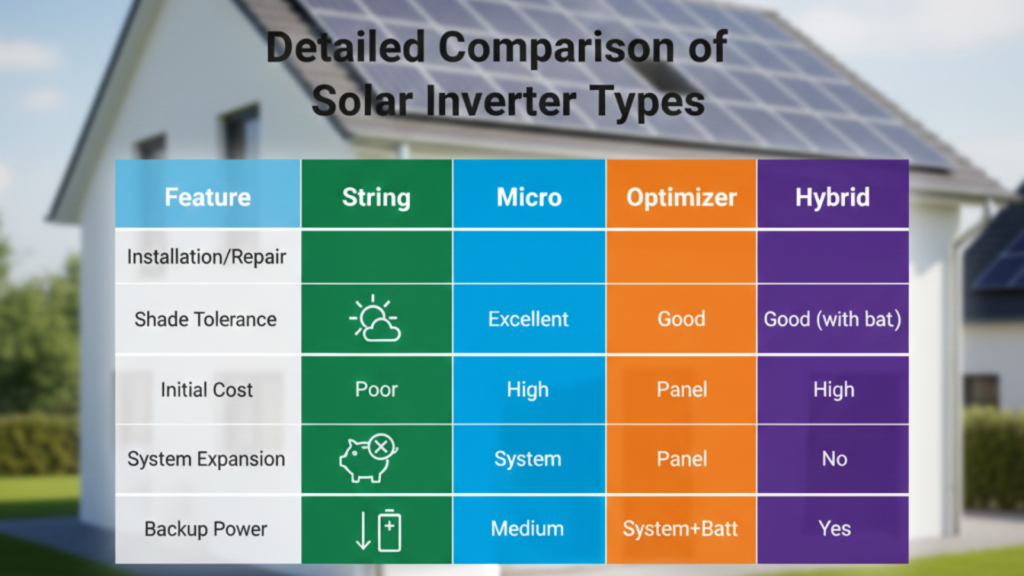
To help you compare the main residential and commercial types of solar inverters, here is a detailed breakdown of their key attributes:
| Feature | String Inverter | Microinverter | Power Optimizer | Hybrid Inverter |
| Placement | Single unit, typically on a wall | One small unit per panel (on the roof) | One unit per panel (on the roof) + Central String Inverter | Single unit, typically on a wall |
| DC-to-AC Conversion | Centralized | At each individual panel | Centralized (DC optimized at panel level) | Centralized, with integrated battery management |
| Performance in Shade | Poor (entire string drops) | Excellent (each panel works independently) | Very Good (panel-level optimization prevents string effect) | Varies (Based on underlying string/optimizer tech) |
| Initial Cost | Lowest | Highest | Medium-High | High (due to battery readiness) |
| Monitoring | System-level only | Panel-level (detailed) | Panel-level (detailed) | System-level and Battery Status |
| System Expansion | Difficult (may require a new inverter) | Easy (add a panel + microinverter) | Moderate (add a panel + optimizer) | Easy (designed for future battery integration) |
| Backup Power (Blackout) | No (Shuts down) | No (Shuts down) | No (Shuts down) | Yes (Provides backup power when paired with a battery) |
Which Type of Solar Inverter is Right for You?

Selecting the right inverter depends on a careful evaluation of your property’s characteristics, your budget, and your long-term energy goals. Consider the following scenarios:
Simple, Unshaded Roof and Tight Budget
- Recommendation: String Inverter
- Why: If your roof is largely unshaded throughout the day, the panels all face the same direction (e.g., south), and cost is your primary concern, a string inverter offers the best balance of simplicity and affordability. The efficiency loss from minimal shading will be outweighed by the lower upfront cost.
Complex Roof Layout or Significant Shading
- Recommendation: Microinverters or Power Optimizers
- Why: For roofs with multiple angles, different orientations (e.g., East and West), or partial shading from trees, chimneys, or vents, you need Module-Level Power Electronics (MLPE).
- Choose Microinverters for maximum energy harvest, the best monitoring, easiest future expansion, and superior safety.
- Choose Power Optimizers if you need high performance and panel-level monitoring but want a slightly lower price point than microinverters.
Need for Energy Backup and Future-Proofing
- Recommendation: Hybrid Inverter
- Why: If you live in an area with frequent power outages, want to store excess solar energy to use at night (self-consumption), or are actively planning to add a solar battery system within the next few years, a hybrid inverter is essential. It provides the necessary infrastructure to manage both solar production and energy storage seamlessly.
Key Factors to Consider When Choosing Solar Inverter Types
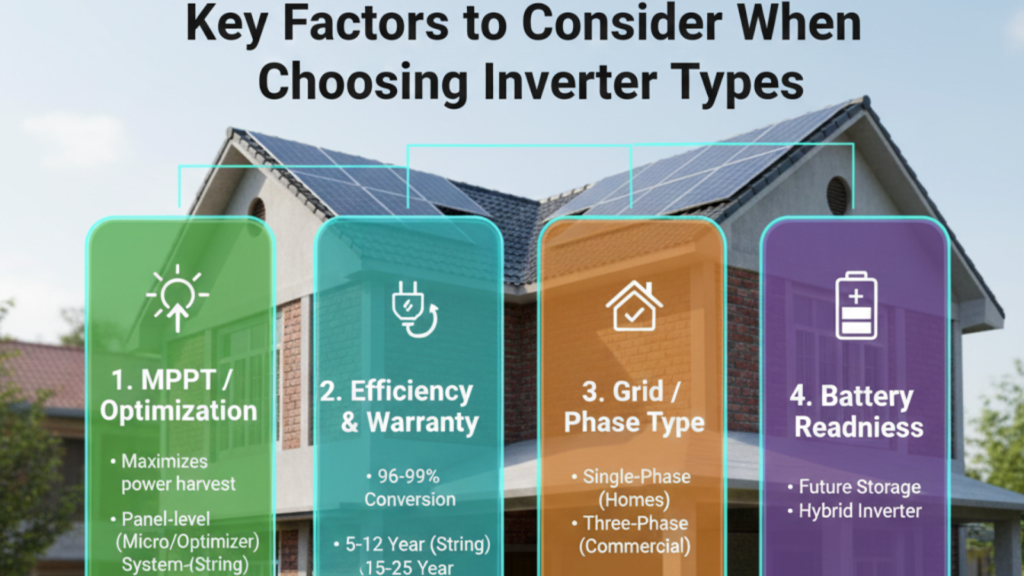
Beyond the four primary types of solar inverters, several technical and practical factors influence your final choice.
1. Maximum Power Point Tracking (MPPT)
MPPT is a critical function that optimizes the panel’s output voltage and current to harvest the maximum possible power under changing conditions (temperature, sunlight intensity).
- String Inverters typically have 1-2 MPPT trackers for the entire system.
- Microinverters and Power Optimizers provide panel-level MPPT (an optimizer or a microinverter for each panel), which is the key reason for their higher performance in shaded conditions.
2. Efficiency Rating
The conversion efficiency is the percentage of DC power the inverter can successfully convert into AC power. Modern, high-quality inverters (of all types) typically achieve efficiencies between 96% and 99%. While small, the cumulative efficiency gain over 25 years can be significant.
3. Warranty and Reliability
Inverters are one of the most hardworking components of a solar system.
- String Inverters typically come with a standard 5-12 year warranty.
- Microinverters often boast longer warranties, frequently 25 years, because they are exposed to the elements and harder to replace.
- Always choose reputable brands with long-standing track records.
4. Grid Connection Type
Ensure your inverter is compatible with your home’s electrical connection. Residential properties usually use single-phase power, while larger commercial systems typically require three-phase inverters.
Inverter Lifespan and Replacement Cost Comparison
The lifespan of your inverter will influence the long-term cost of your system. Replacing a large central inverter is simpler than replacing multiple units on a rooftop.
| Inverter Type | Expected Lifespan (Years) | Replacement Cost Implication |
| String Inverter | 10 – 15 years | Lower replacement cost for a single unit. |
| Microinverter | 20 – 25+ years | High initial cost, but potentially no replacement needed during the solar panel’s lifespan. |
| Power Optimizer | 20 – 25+ years | Lower cost for optimizer replacement, but central inverter will still need to be replaced every 10-15 years. |
| Hybrid Inverter | 10 – 15 years | Higher replacement cost due to integrated, complex technology. |
Conclusion: The Final Choice of Solar Inverters
The decision of which type of solar inverter to install hinges on the delicate balance between cost and performance optimization.
For the homeowner with a straightforward, unshaded roof and a focus on minimizing upfront expenses, the String Inverter remains a reliable, cost-effective choice.
However, if your roof is complex, prone to shading, or if you simply demand the highest possible energy harvest and best monitoring, investing in Microinverters or Power Optimizers is the smarter, more future-resilient decision.
Finally, for those who prioritize energy independence and wish to integrate battery storage, the Hybrid Inverter provides the necessary foundation for a comprehensive, blackout-proof solar solution.
Consult with a certified solar installer to get a professional assessment of your roof and system design. They can accurately determine which of the types of solar inverters will deliver the maximum lifetime value for your specific energy needs.
Frequently Asked Questions (FAQ) about Types of Solar Inverters
Q1: What is the main difference between DC and AC power?
A: Solar panels produce Direct Current (DC) electricity, which flows in a single direction. Household appliances and the utility grid use Alternating Current (AC) electricity, where the current direction rapidly switches. The fundamental job of all solar inverters is to convert the raw DC power into usable AC power.
Q2: Why is shading such a problem for string inverters?
A: String inverters connect panels in a series, much like old Christmas lights. The total current for the entire string is limited by the panel producing the least current (the shaded panel). This is called the “string effect,” which dramatically reduces the energy output of the entire array. Microinverters and power optimizers solve this by allowing each panel to operate independently.
Q3: Are microinverters worth the higher cost?
A: Yes, in many cases. Microinverters offer higher energy production (especially on shaded or complex roofs), panel-level monitoring, and longer warranties (often 25 years). If you have shading issues, want maximum system visibility, or plan to expand your system, the long-term energy yield and maintenance benefits often justify the higher initial expense.
Q4: Can I add a battery to a system with a string inverter?
A: You can, but it requires adding a separate component called an AC-coupled battery inverter to manage the battery. A Hybrid Inverter is a better, more efficient option because it integrates the solar conversion and battery charge control into one streamlined unit.
Q5: What is an MPPT tracker, and why is it important?
A: MPPT stands for Maximum Power Point Tracking. It is a crucial algorithm within the inverter (or optimizer/microinverter) that constantly adjusts the electrical load to ensure the solar panel is operating at its point of maximum power output, thus maximizing energy harvest throughout the day as sunlight intensity changes.
